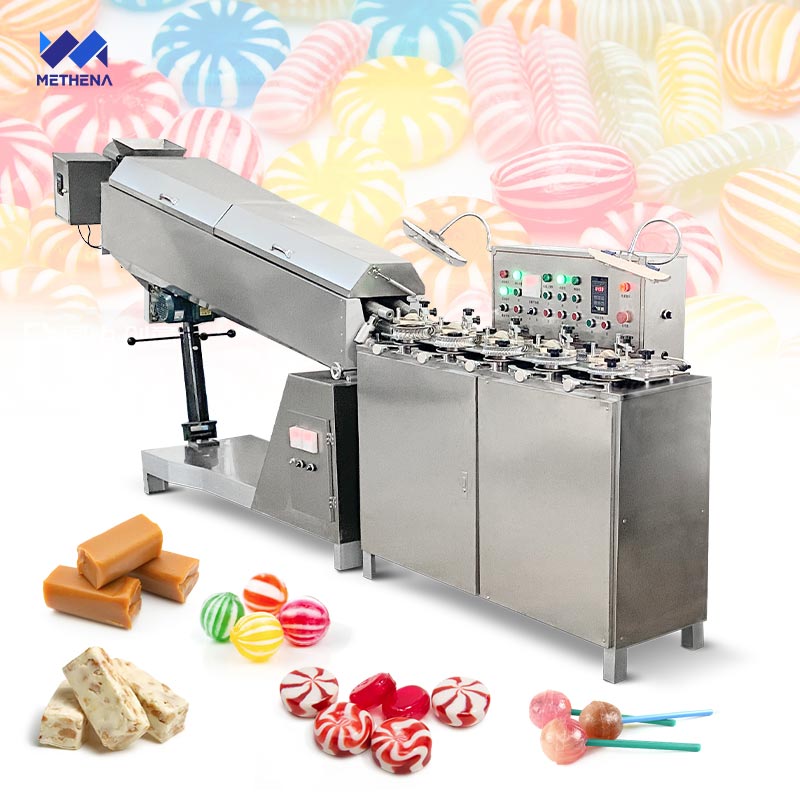
On a lollipop or hard candy line, whether the forming machine runs cleanly depends mostly on the rope it is fed. Mass coming off the cooling table is rarely uniform: the outside has set while the core is still soft, and feeding that straight into a forming machine produces rope breaks, tapered ends and partly set lumps. Hand-flattening and repeated re-warming suppress the symptoms, but the rhythm never keeps up with the conveyor, and the mass keeps losing heat while it waits, which makes the later portion harder to draw than the first.
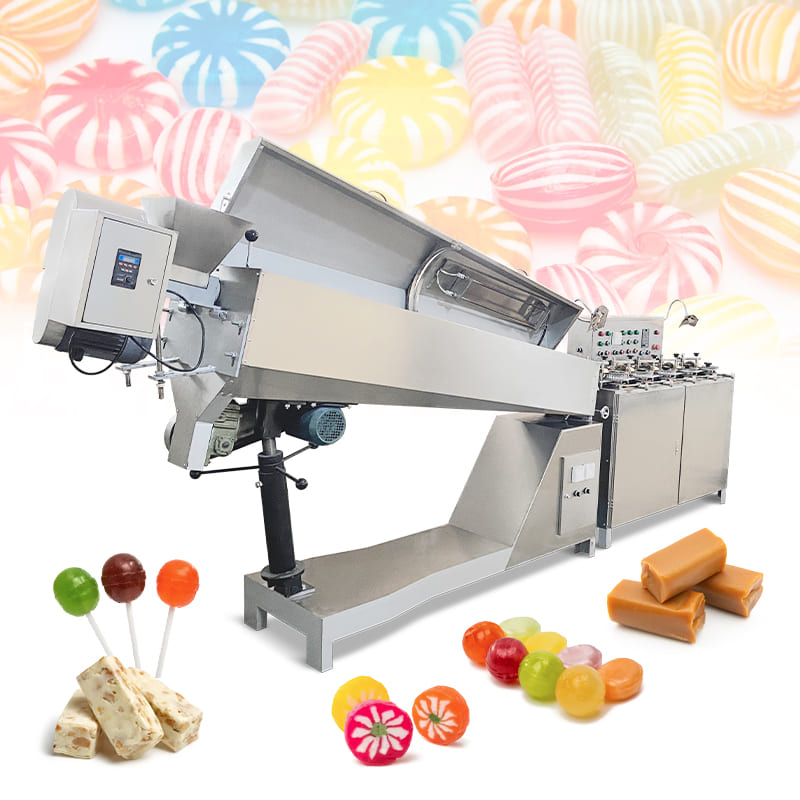
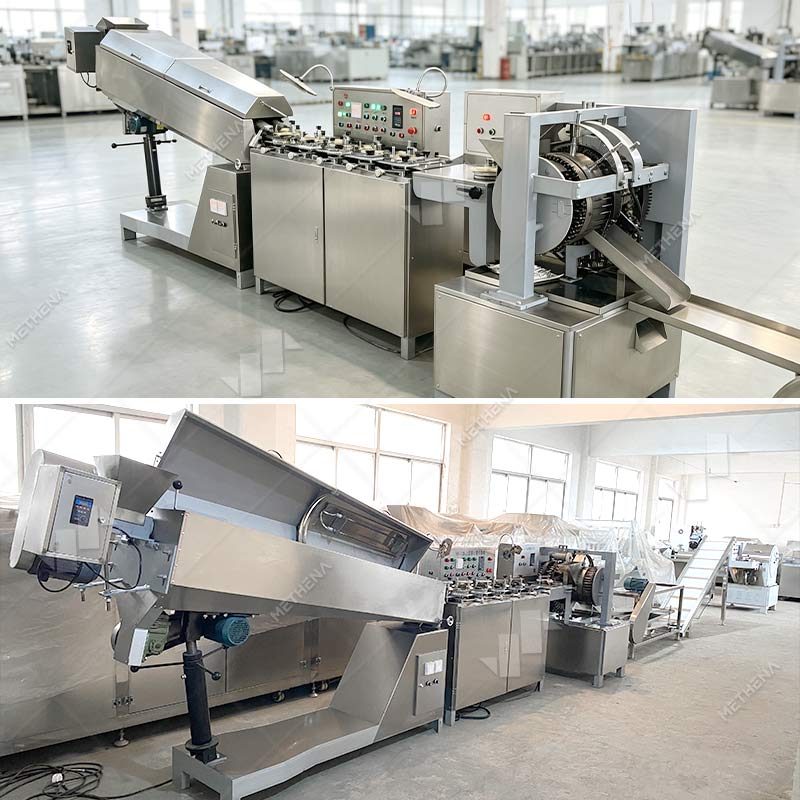
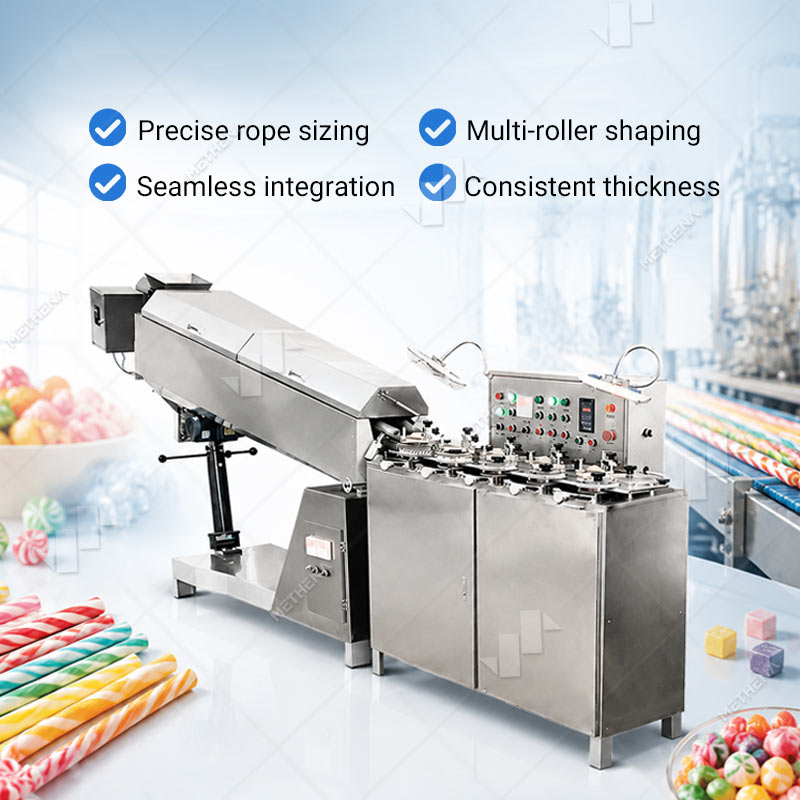
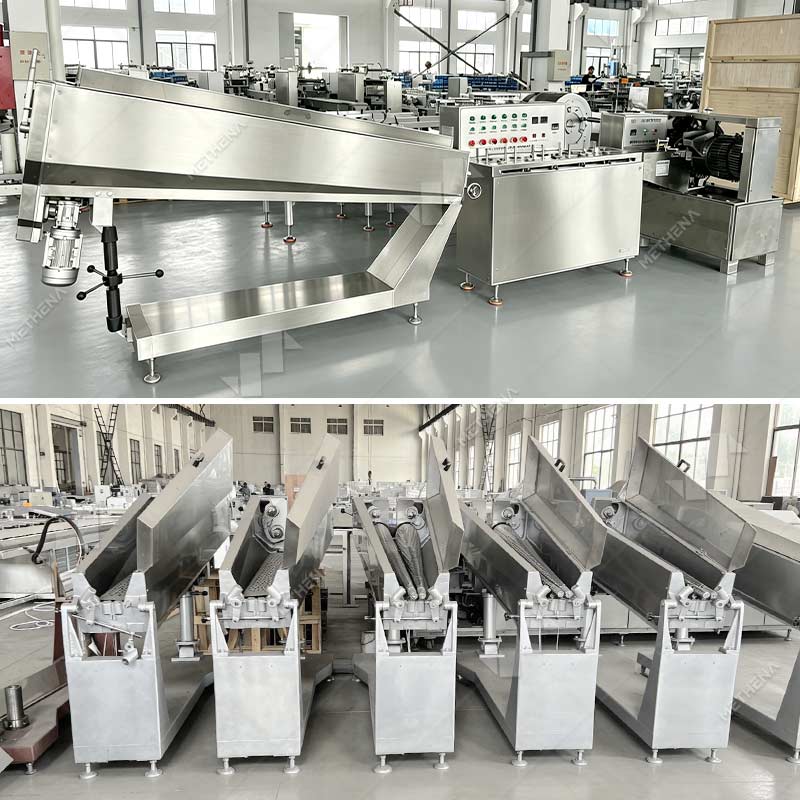
The batch roller and rope sizer split the job into two controlled stages. The batch roller holds the mass at temperature and kneads it into a conical column of even plasticity; the rope sizer then reduces that column to the diameter the forming machine needs through a set of adjustable-gap rollers. Once rope diameter is stable, piece weight off the forming machine is stable. The problem this equipment solves is not whether a rope can be produced, but whether every metre of that rope follows the same diameter curve.
▸ Configuration: batch roller and rope sizer in series, two-stage rope preparation
▸ Function: keeps sugar mass plastic and kneads it into a conical column, then draws it down to the target rope diameter for the forming machine
▸ Rope diameter: 25–35 mm (roller gap adjustable; other diameters on request)
▸ Output: 100–300 kg/h; 150–300 pcs/min, speed matched to the forming machine
▸ Power: batch roller 4.75 kW + rope sizer 3.3 kW; electric heating; 220 V / 380 V
▸ Build: thickened SUS304 stainless steel; programmable control; continuous duty
▸ Applications: lollipop, hard candy, toffee; ball, round, oval or custom shapes
▸ Certification: ISO 9001 / ISO 14001 / ISO 45001 / CE / BSCI / ETL; 1-year warranty
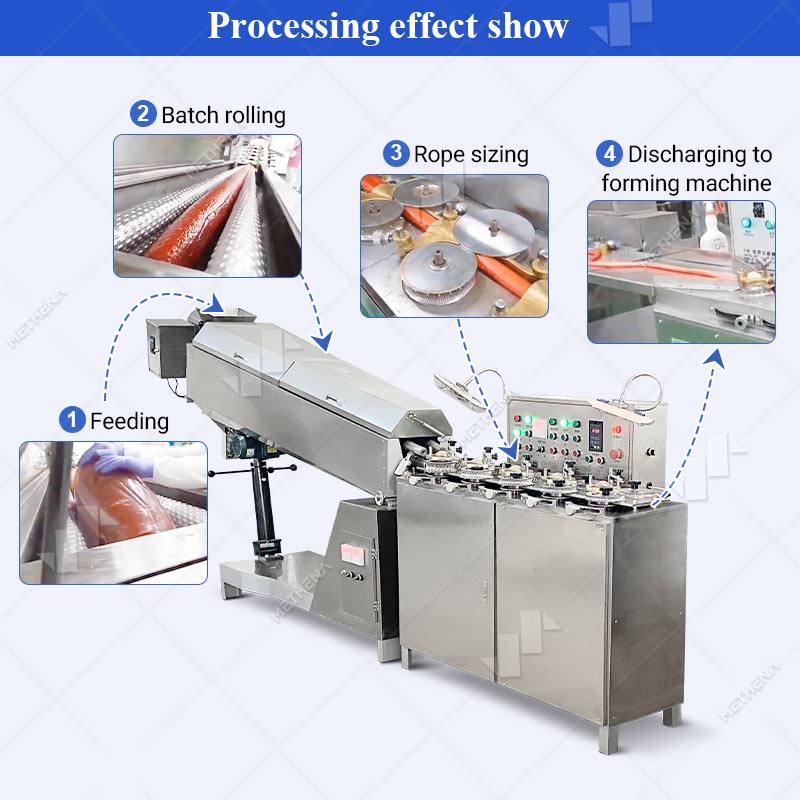
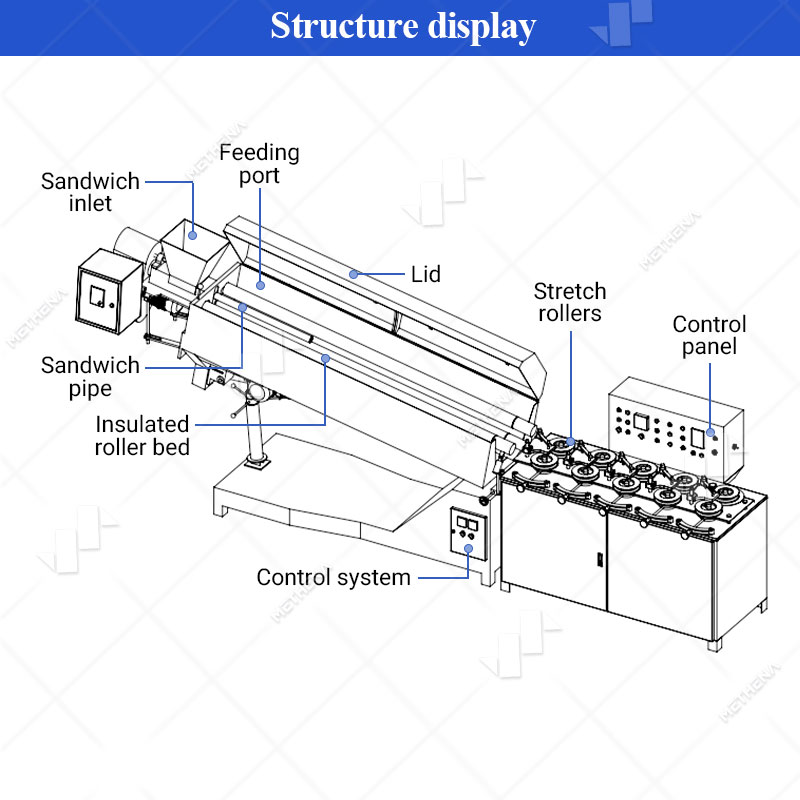
Stage one, heated roller bed. Mass from the cooling table drops into an insulated roller bed where conical rollers turn and knead it continuously. Kneading removes internal temperature differences: hot core material is folded outward, stiffened outer material returns to the centre, and after a few revolutions the whole batch sits in one temperature band. Uniform plasticity is the precondition for continuous drawing, since a mass with steep internal gradients tears the moment it is pulled.
Stage two, forming the cone.The bed gathers the mass into a conical column instead of loose lumps. A tapered, closed cross-section is what lets the column enter the next stage at a steady rate rather than piling up at the roller inlet.
Stage three, staged reduction.The column enters the rope sizer roller set, where the gap between rolls sets the final diameter. Reduction happens in stages rather than in one pass. A single aggressive pass leaves stress marks on the surface and can pull voids into the interior. Because the gaps are adjustable, one rope sizer covers the 25–35 mm band; diameters outside that range need a custom roller set.
Stage four, pacing and delivery.Drawing speed is set against the consumption rate of the forming machine, and the two have to stay synchronized. Too fast and the rope is stretched thin, giving light pieces; too slow and a slack loop forms between the two machines, which tends to twist. Speed is adjustable across 150–300 pcs/min to suit the downstream machine.
Parameter | Batch Roller | Rope Sizer |
Power | 4.75 kW | 3.3 kW |
Weight | 450 kg | 430 kg |
Dimensions (L×W×H) | 2100×600×1150 mm | 1400×800×1300 mm |
Output rate | 150–300 pcs/min | 150–300 pcs/min |
Function | holding, kneading, forming the conical column | staged reduction to target diameter |
Item | GD-CBRS (combined set) |
Capacity | 100–300 kg/h |
Rope diameter | 25–35 mm (roller gap adjustable; other diameters on request) |
Raw material | sugar (mass/syrup) |
Suitable products | lollipop, hard candy, toffee |
Final shapes | ball, round, oval, customized |
Material | thickened SUS304 stainless steel (customizable) |
Heat source / drive | electric heating, motor drive |
Voltage | 220 V / 380 V (other supplies on request) |
Control | programmable, continuous duty |
Warranty | 1 year |
Certification | ISO 9001 / ISO 14001 / ISO 45001 / CE / BSCI / ETL |
Site-dependent items such as residual-current protection, foundation and layout must be confirmed item by item with the supplier before ordering.
Heated bed and conical rollers.
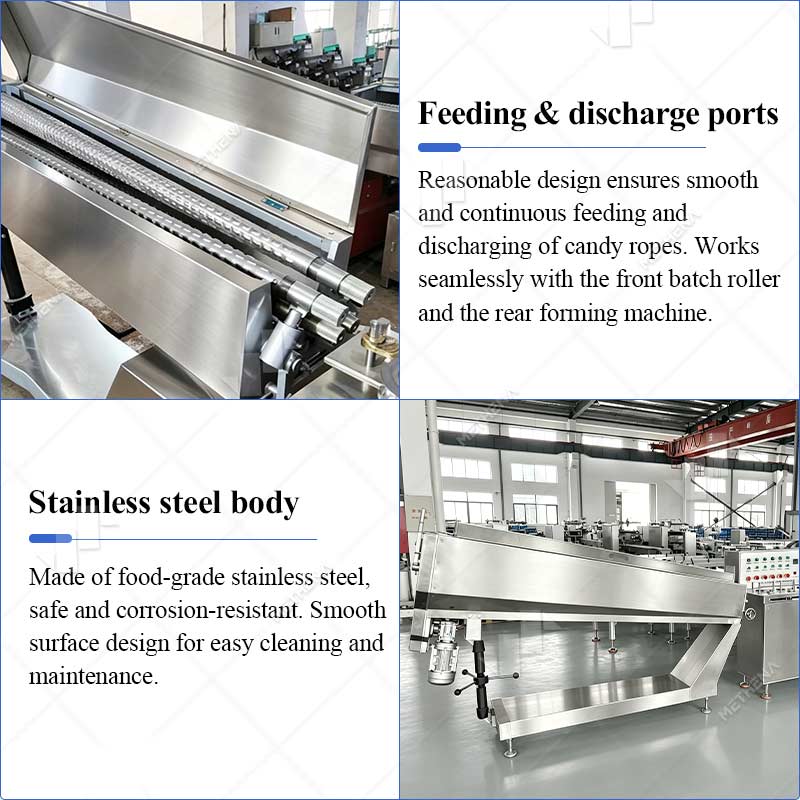
The bed both holds temperature and kneads, with thickened SUS304 stainless steel on food-contact surfaces. Thickness is not only a durability point: the rollers take repeated reaction loads while kneading, and a frame that lacks rigidity will let the roller gap drift in service, which shows up on the line as unstable rope diameter.
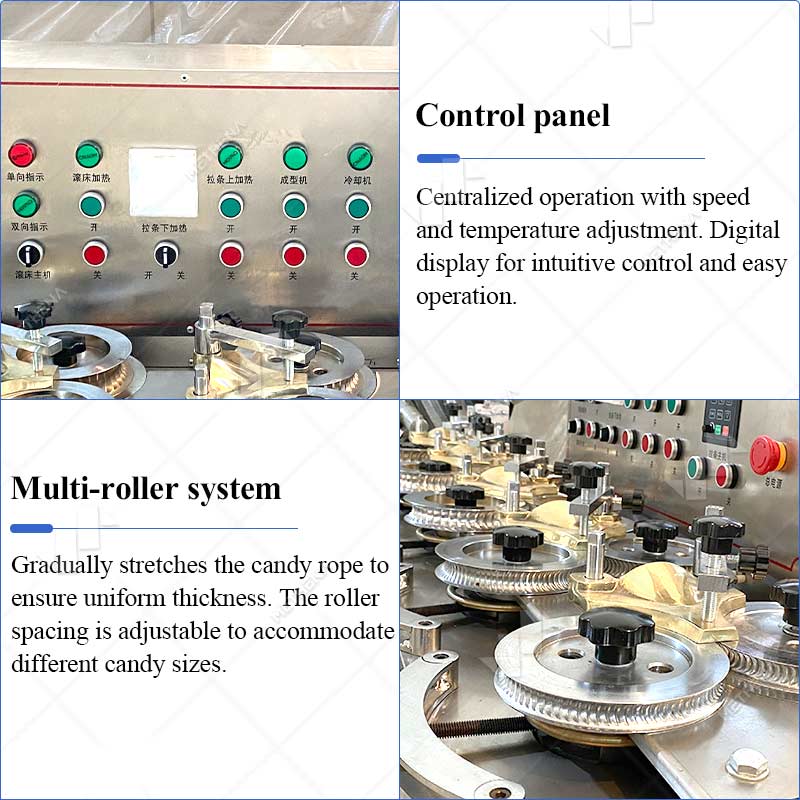
Rope sizer roller set. These rollers are the parts that set rope diameter, and their gap is the adjustment. Surface condition shows up directly on the rope: once dried sugar adheres to a roll, the rope develops a periodic ridge. The set is arranged in stages so diameter steps down gradually.
Drive and control. Heating is electric and drive is by motor, so no steam boiler is needed. Control is programmable; bed temperature and drawing speed are set and stored per recipe, so a product change is a recall rather than a judgement call.
Frame and noise. The frame is thickened stainless steel built for continuous duty. Low noise matters beyond comfort: on this type of machine, noise usually comes from drive backlash and vibration, and that vibration transfers straight into the rope as surface ripple.
Step 1, preheat and set. Power up and set bed temperature and drawing speed against the recipe. Different candy bodies have different workable temperature bands; the correct setting is the one where the mass draws continuously without breaking.
Step 2, charge. Feed cooled mass into the heated bed. Keep a stable inventory in the bed: too little mass makes discharge intermittent and produces cyclic thick-thin variation in the rope.
Step 3, knead and cone. Let the bed knead until temperature is uniform and a conical column has formed, then thread the leading end into the sizer rolls.
Step 4, set diameter. Adjust the roller gap, draw a test length and measure the rope. Confirm it sits inside the 25–35 mm target before running continuously.
Step 5, match pace. Set drawing speed to the actual consumption of the forming machine and watch the loop between the two machines: neither taut nor slack.
Step 6, clean down. After stopping, clear residual sugar from the bed and rolls, return the gaps to a recorded setting and log the batch parameters for the next run.
Daily cleaning. Dried sugar on the rolls and in the bed scratches every rope that follows, so a clean-down at shift end costs far less than later descaling. Pay attention to roller grooves and dead corners in the bed, where sugar collects most.
Inspection and wear items. The supplier documentation lists no mandatory wear parts. Against field conditions, the following rhythm is suggested as engineering guidance rather than a standard:
Item | Suggested interval | Action signal |
Roller surface and gap | before each shift | clean off any hardened sugar; re-set on gap drift |
Drive chain / belt | monthly tension and wear check | replace on slip, tooth jump or noise |
Bearings and drive lubrication | per supplied manual | service on abnormal heat or noise |
Bed heating elements | insulation and warm-up check yearly | replace on slow heating or RCD trip |
Electrical cabinet | quarterly dust removal and terminal check | investigate on parameter drift or poor contact |
Installation environment. The batch roller weighs 450 kg over roughly 2100×600 mm and the rope sizer 430 kg over roughly 1400×800 mm, which puts floor loading in the 350–400 kg/m² range; normal hardened flooring is sufficient, but confirm slab capacity for upper-floor or mezzanine installation. Arrange the two units and the downstream forming machine in a straight run and avoid sharp turns in the rope path. Keep at least 80 cm of access around the machines for operation and service, and leave overhead space for charging and observation.
Give each machine its own circuit with residual-current protection, sized for 4.75 kW and 3.3 kW respectively, and confirm 220 V or 380 V supply at order stage. Heating is electric, so no steam boiler is required. Ventilate the room to carry off radiant heat from the mass, and keep the floor easy to clear of sugar scrap.
1. Weight compliance is fixed at the diameter stageRope diameter and piece weight are related by the square: on a 30 mm rope, a 1 mm deviation shifts the cross-section by roughly 6.7%, which lands on the finished piece as overweight or underweight. Overweight is sugar given away; underweight brings complaints and inspection risk. At a conservative 100 kg/h over an 8-hour shift, 2% systematic overweight means about 16 kg of sugar handed out per shift. With adjustable roller gaps and staged reduction, diameter holds near setpoint and that loss narrows.
2. Less reheating and scrapping from heat lossMass that sets while waiting is one of the most common hidden losses on a candy line. Hardened mass either returns to the cooker, which costs another heating cycle, or is scrapped. The heated roller bed kneads continuously and holds temperature, widening the window in which the mass stays workable, so operators no longer have to speed up the line just to stay ahead of cooling.
3. Output pacing matches the forming machine, fewer break-related stopsDrawing speed is adjustable across 150–300 pcs/min and is set against the consumption rate of the downstream machine. When the two drift apart, over-speed stretches the rope thin and pieces come out light; under-speed leaves a slack loop between the machines that twists. With the rates matched, rope no longer needs manual correction and short stops from breaks drop off.
4. The station stops depending on operator feelMoving, flattening and hand-testing mass between the cooling table and the forming machine was heavy work that relied on experience. Continuous mechanical handling changes the job to reading parameters and setting gaps, which shortens training, lowers physical load, and reduces quality swing when the operator changes.
5. Product change becomes a recipe recall, not a trial runBed temperature and drawing speed are set and stored per recipe, so a changeover is a recall rather than a judgement call. One roller set covers the 25–35 mm band, so standard sizes need no tooling change; only diameters outside that range require a custom roller set. Sugar lost and time spent during trial drawing both come down.
6. Electric heating in two separate units, no boiler and no standby lossTotal connected load is 8.05 kW (4.75 kW roller plus 3.3 kW sizer) and the heat source is electric, so no steam boiler, boiler attendant, or standby heat loss is involved. Food-contact surfaces are thickened SUS304 that withstands the repeated reaction load of kneading, keeping the roller gap from drifting in service and reducing how often rope diameter needs recalibration. At 450 kg and 430 kg, the two units can be positioned separately and fed from separate power circuits.
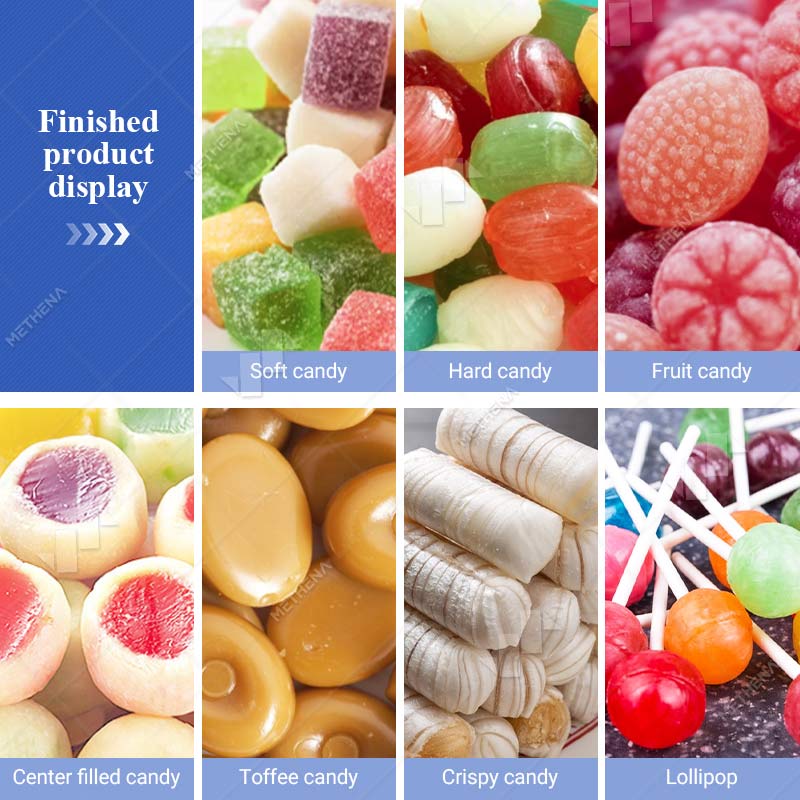
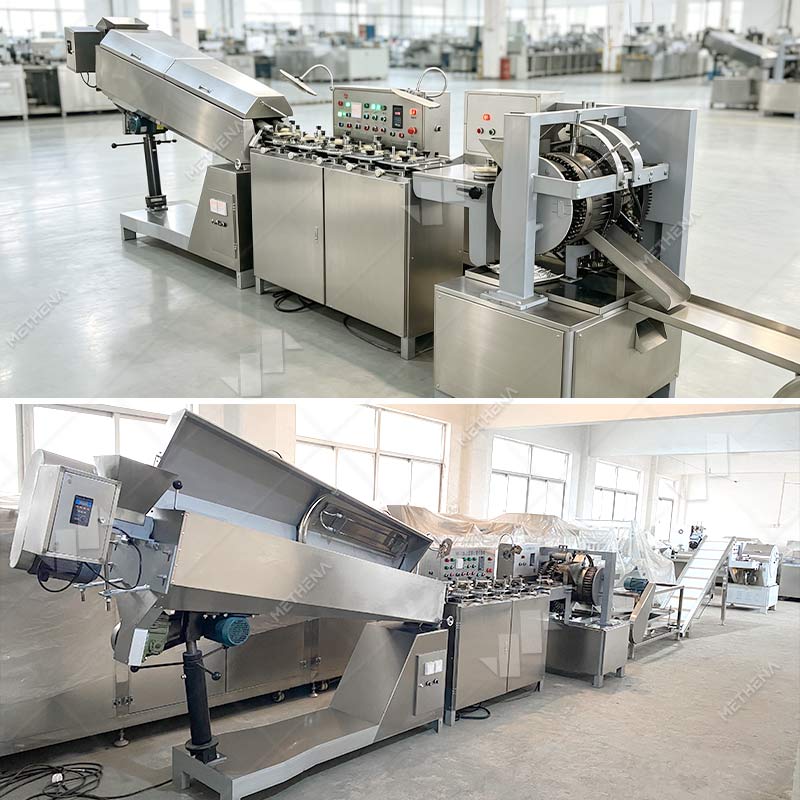
Lollipop production lines.This is the quintessential application for rope-forming and sizing machines: syrup cooked in a kettle is cooled into a mass on a cooling table, then fed into a rope-forming machine for thermal conditioning and kneading. Next, a sizing machine stretches it into a rope of uniform diameter before feeding it into the lollipop forming machine, where the candy is pressed into a ball and the stick is inserted. The weight consistency of the finished lollipops largely depends on this stage.
Hard candy factories.Hard candies—such as fruit-flavored or mint candies—are equally sensitive to the diameter of the candy rope; fluctuations in diameter translate directly into variations in the weight of individual pieces. The continuous feeding provided by the rope-forming and sizing process allows the forming machine to operate at a steady speed for extended periods.
Toffee and milk candy production.Toffee is highly viscous and has a narrow temperature window for processing, making the benefits of a heated rope-forming bed particularly evident: the candy mass does not require repeated reheating, thereby avoiding the burnt flavors and discoloration associated with repeated heating cycles.
Q1. What materials and products suit this machine?The raw material is sugar, in mass or syrup form, and the machine serves lollipop, hard candy and toffee production. Finished shapes cover ball, round, oval and custom forms, with the final shape set by the downstream forming tooling.
Q2. Can the batch roller and the rope sizer be bought separately?The two work in series: the batch roller holds, kneads and cones the mass, and the rope sizer reduces it in stages. Either unit can be supplied alone to fill a gap in an existing line, though the full benefit comes from running both.
Q3. What rope diameters are achievable?The standard band is 25–35 mm, set by adjusting the roller gap. Diameters outside that range need a custom roller set, and a sample trial is recommended first.
Q4. Will it match my existing forming machine?Yes. Drawing speed is adjustable across 150–300 pcs/min and set to the forming machine's actual consumption rate. Provide the forming machine model and rate so the matching range can be confirmed.
Q5. What material touches the product?Thickened SUS304 stainless steel, with other material specifications available on request. The thickened build keeps roller rigidity under sustained kneading loads so the gap does not drift and change rope diameter.
Q6. What are the power and voltage requirements?Batch roller 4.75 kW and rope sizer 3.3 kW, with electric heating. Standard supply is 220 V or 380 V with other configurations on request, and each machine should have its own circuit with residual-current protection.
Q7. What is the delivery time and packing method?Standard configurations ship in about 16 days, with roughly 30 days above five units. Machines are film-wrapped and crated; a single crate is about 230×80×150 cm at roughly 550 kg gross. Custom configurations are scheduled before the order is placed.
Q8. When is this machine not the right choice?Gummies, marshmallows and aerated confections are deposited rather than drawn and do not suit it, and chocolate tempering and depositing are outside its scope. Masses with nut pieces or crisp inclusions can break rope continuity and need a sample test. Line throughput is ultimately capped by the downstream forming machine.










 Request a Quote
 More Products