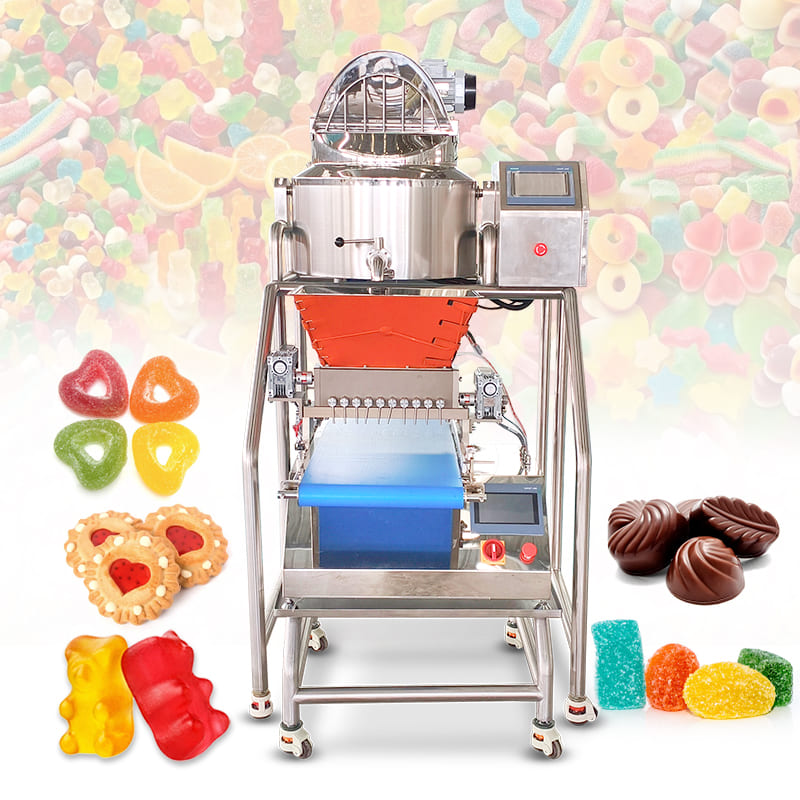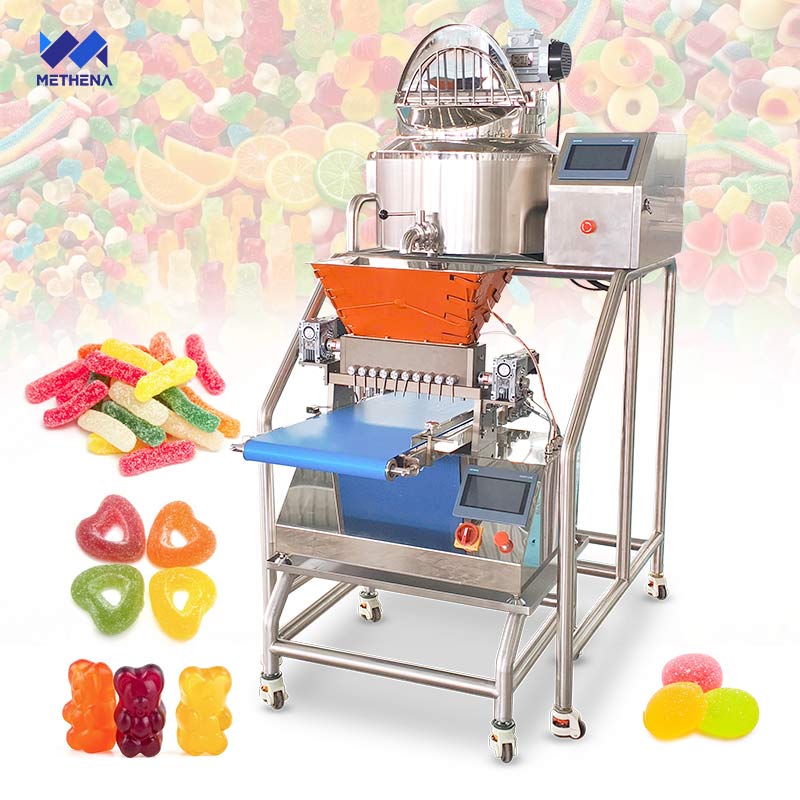
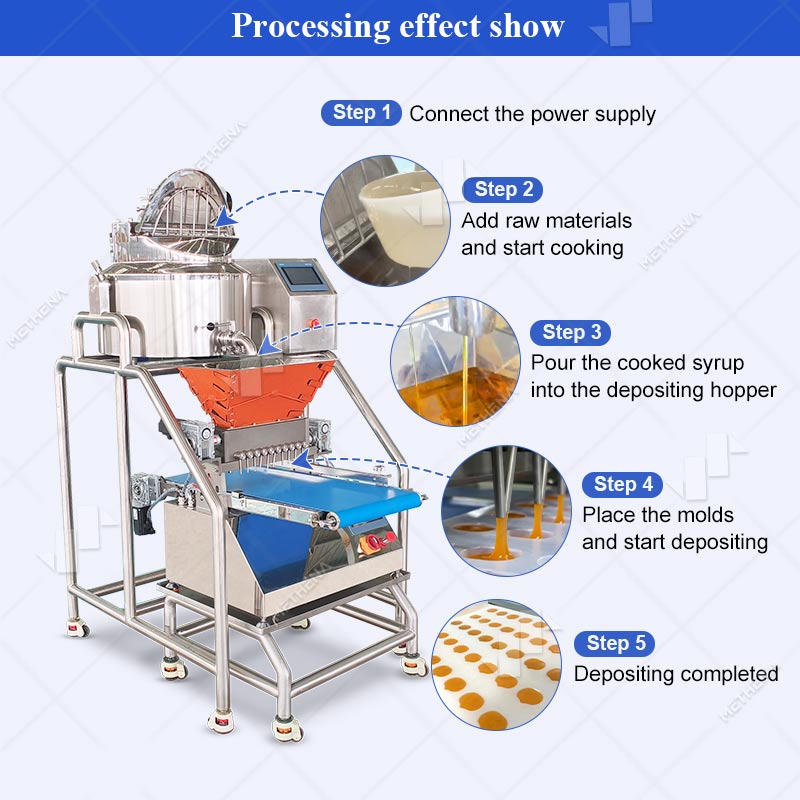
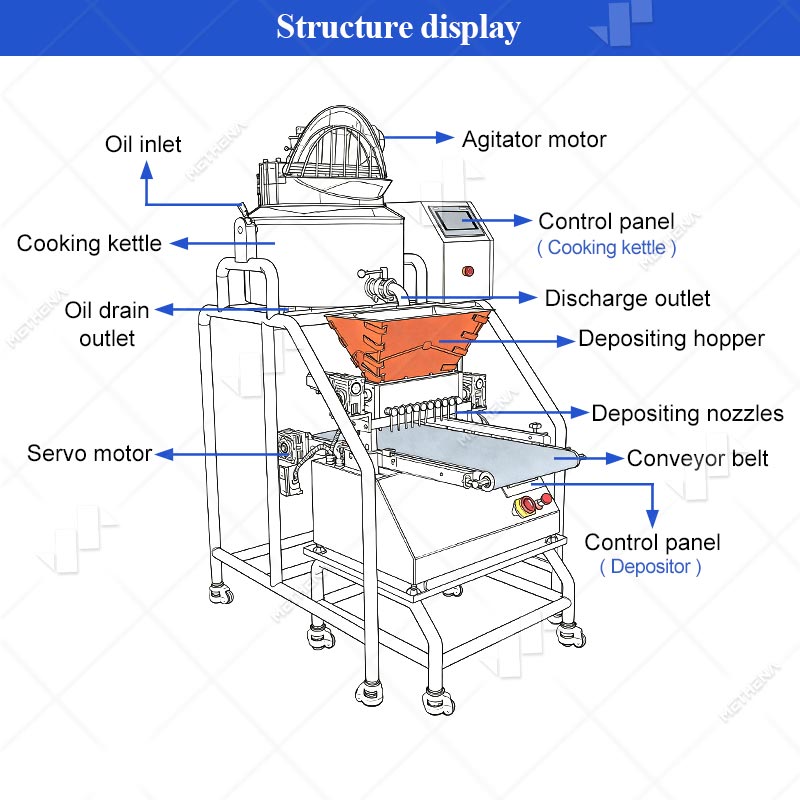
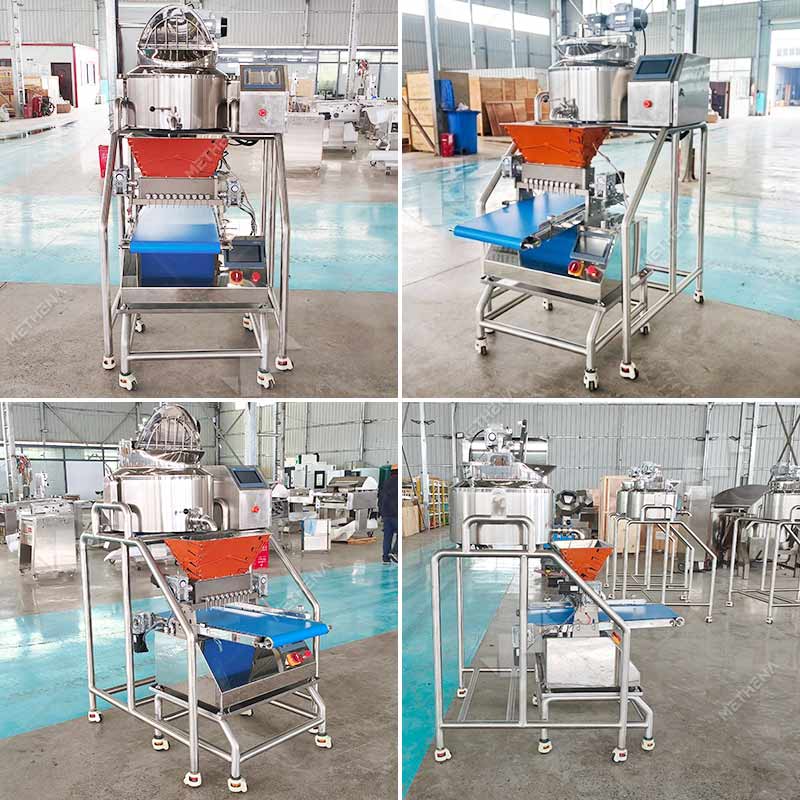
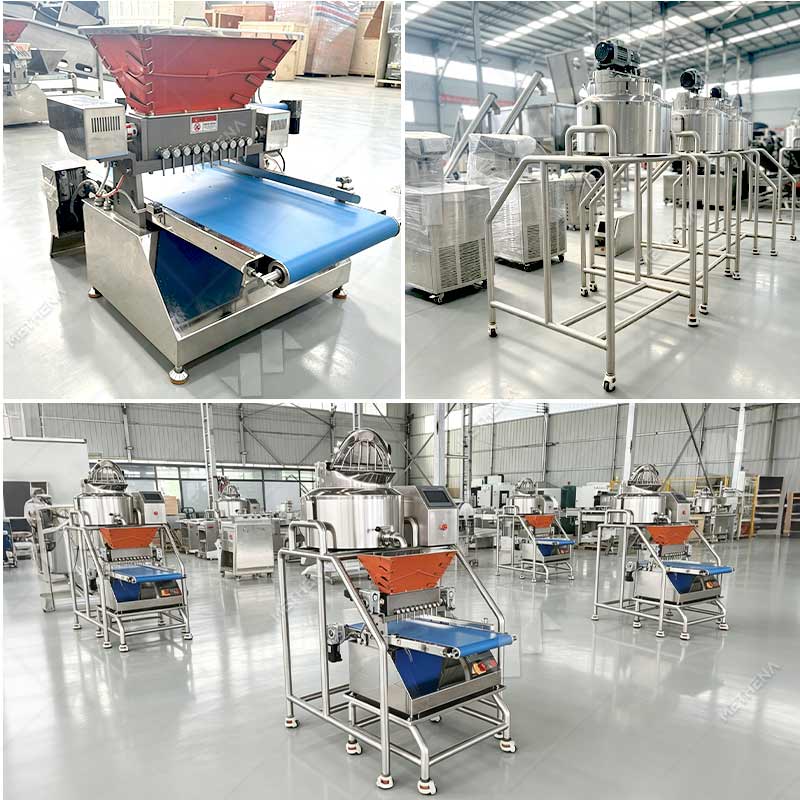
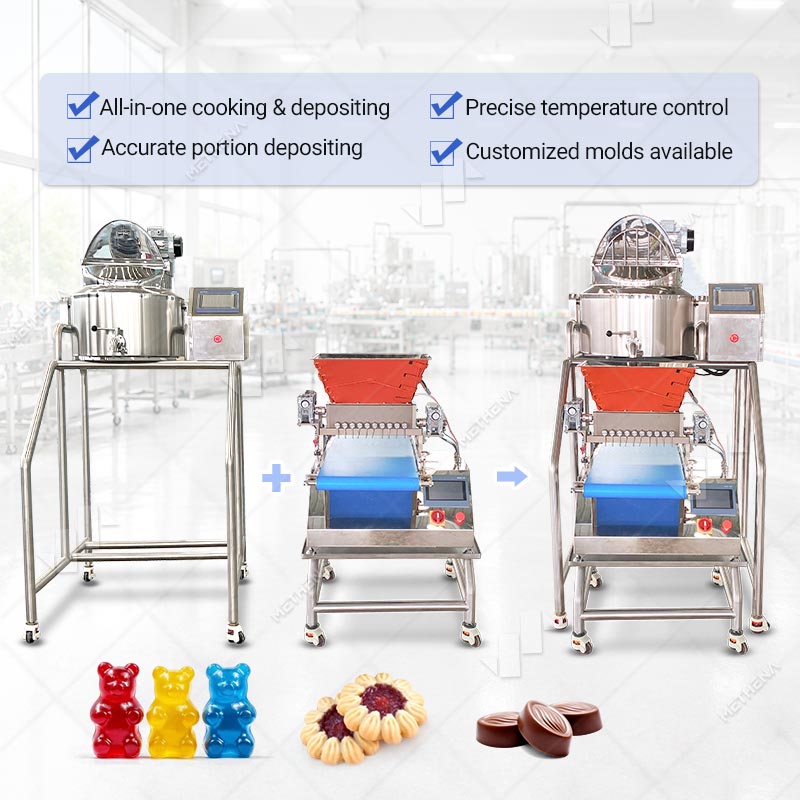
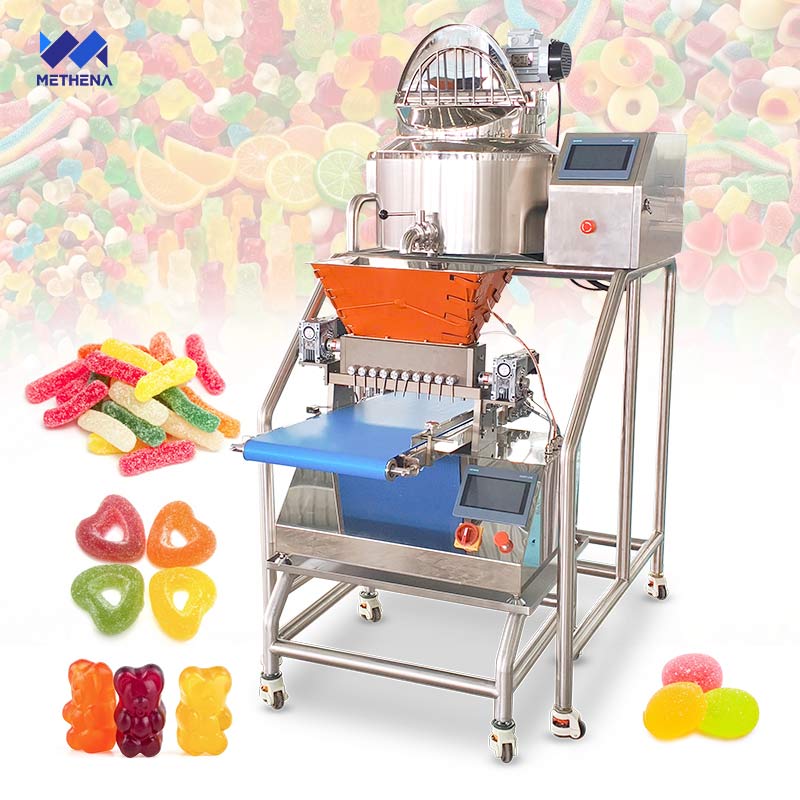
The MET-KCPM Candy Cooking & Depositing All-in-One Machine integrates sugar boiling, heat preservation, and quantitative pouring into a single machine, eliminating manual transfer of the syrup from the point of preparation to its entry into the pouring nozzle.
It caters to scenarios such as R&D prototyping, small-batch trial production, dessert studios, and chain central kitchens: single-shift output doesn't need to be several hundred kilograms, but high repeatability between batches and rapid recipe changes are required. Its output range of 60–100 kg/h falls precisely in the middle ground between "hand-made pots being too small and continuous production lines being too large," which distinguishes it from large-scale pouring lines.
▸ Machine type: single all-in-one unit combining syrup cooking, holding and depositing, for R&D and small-to-medium batch candy output
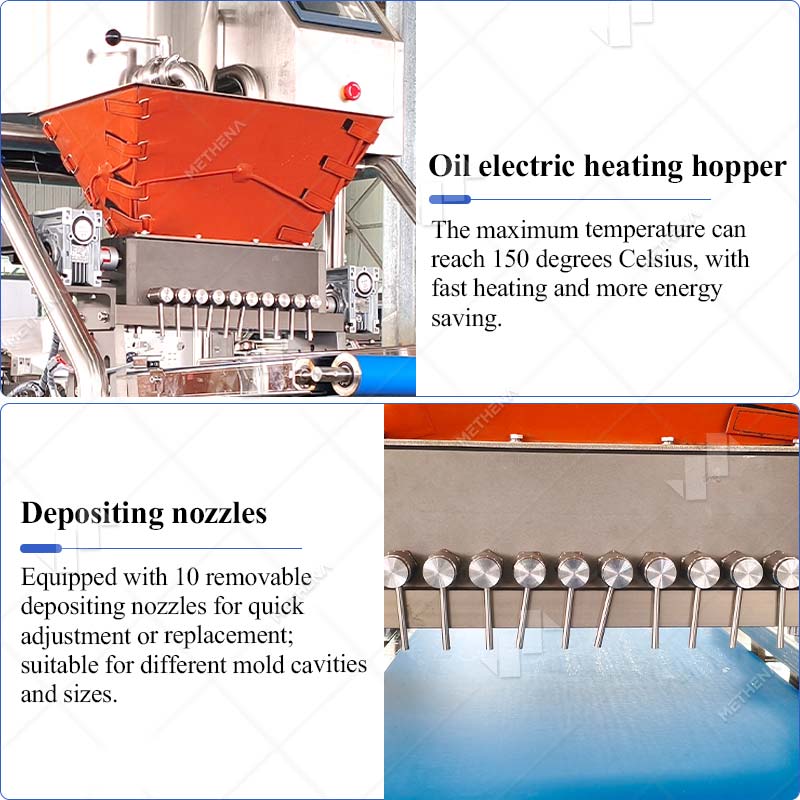
▸ Output: 60–100 kg/h; 30–60 deposits/min; 10 depositing nozzles/pistons
▸ Heating: electric thermal-oil jacket, PLC temperature control, up to 130 °C; holding hopper jacket rated to 150 °C
▸ Power: 10.55 kW installed (2×5 kW heating elements + 0.55 kW stirrer); 220 V / 380 V
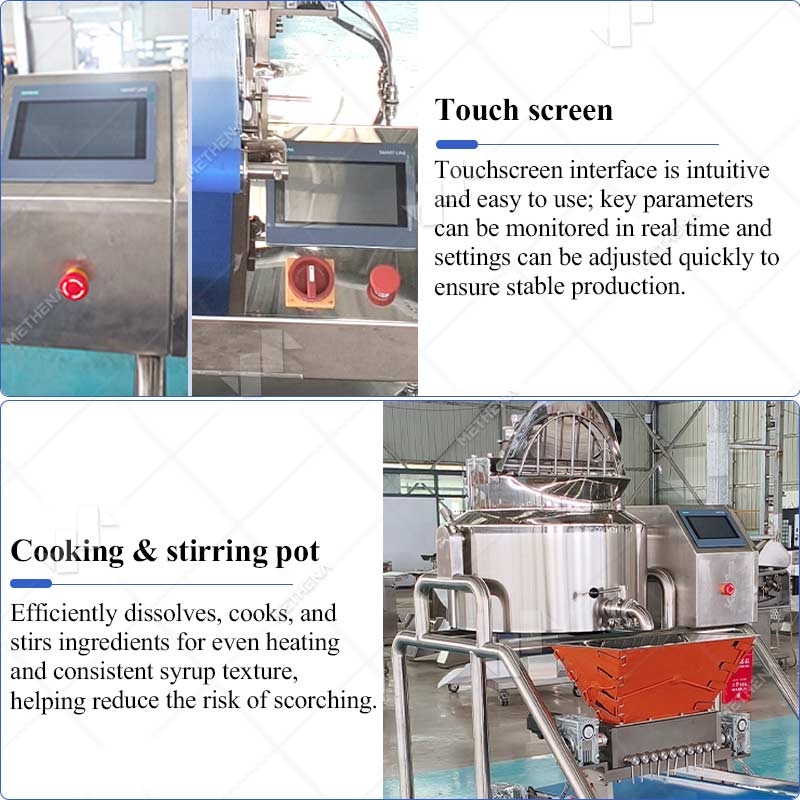
▸ Build: SUS304 food-contact surfaces, dual touchscreen HMIs, all-electric drive, no plant compressed air required
▸ Size: 118×161×225 cm; net weight approx. 470 kg
▸ Certification: ISO 9001 / ISO 14001 / ISO 45001 / CE / BSCI / ETL
Candy Cooking Depositing All-in-One Machine: Working Principle and Process
The entire machine operates in six stages, coordinated by a PLC. The operator's role is to set parameters and monitor the status, not to judge the heat.
Stage 1: Ingredient Input
Sugar, syrup, water, and colloidal or oily ingredients are weighed according to the formula and added to the sugar-cooking mixing pot. The pot is equipped with a heat-conducting oil jacket, transferring heat through the jacket instead of directly heating the bottom of the pot. This is a prerequisite for controlling the risk of caramelization later.
Stage 2: Heating and Cooking
Two 5 kW electric heating elements heat the heat-conducting oil, while a 0.55 kW stirring motor drives the stirring paddle via a frequency converter, continuously agitating the syrup while it is heated. Adjustable stirring speed is crucial: different material viscosities require different shear and agitation intensities. A pot with a fixed speed is prone to creating dead zones near the paddle when cooking high-viscosity toffee.
Stage 3: Heat Preservation and Transfer
The cooked syrup enters an insulated hopper with an oil-heated jacket, which can reach a maximum temperature of 150 °C. This step ensures the syrup remains in a stable flow state for several minutes before pouring, preventing premature solidification or crystallization of the high-sugar material due to temperature drop.
Stage 4: Quantitative Pouring
Ten pouring nozzles/pistons operate synchronously via servo or frequency converter, completing a quantitative pour with each stroke. The pouring volume and frequency are set on the touchscreen; the minimum single pour volume is 0.2 g, with common settings between 1–7 g. The mold advances with the conveyor belt, and the positioning of the pouring nozzles and mold cavity is controlled by PLC to ensure accurate placement.
Stage 5: Molding and Cooling
The poured silicone mold leaves the pouring area with the conveyor belt, and the candy cools and sets naturally within the mold cavity. The conveyor belt supports single/dual mode switching, allowing adjustment of the operating mode to meet different production demands.
Stage 6: Demolding and Cleaning
After shaping, the candies are removed from the silicone mold and proceed to the subsequent packaging stage. After each batch, an automatic cleaning mode is activated, rinsing the contact surfaces and pouring head with circulating hot water to reduce syrup residue and curdling.
Parameter | GD-KCPM |
Output capacity | 60–100 kg/h |
Depositing frequency | 30–60 strokes/min |
Nozzles/pistons | 10 |
Shot weight | from 0.2 g min.; common 1–7 g settings |
Heating | electric thermal-oil jacket |
Max. set temperature | 130 °C (cooking/holding, PLC) |
Holding hopper jacket | up to 150 °C |
Stirring motor | 0.55 kW, variable-frequency drive |
Heating elements | 2×5 kW |
Installed power | approx. 10.55 kW |
Voltage | 220 V / 380 V, 50/60 Hz |
Control | PLC + dual touchscreen; 2 recipe memories |
Conveyor | single/double mode |
Food-contact material | SUS304 stainless steel |
Molds | silicone; cavity design customizable |
Dimensions (L×W×H) | 118×161×225 cm |
Net weight | approx. 470 kg |
Cleaning | built-in automatic cleaning cycle |
Certification | ISO 9001 / ISO 14001 / ISO 45001 / CE / BSCI / ETL |
3-in-1 Sugar Cooking Pot Operation Procedure
Step 1: Power On and Recipe Loading.
Connect the power supply and select a saved recipe or create new parameters on the touchscreen. Confirm the sugar cooking temperature, stirring speed, pouring volume, and conveyor belt speed.
Step 2: Sugar Cooking.
Weigh the raw materials and add them to the pot. Start heating and stirring, and wait for the syrup to reach the target temperature and state. For high-viscosity recipes, reduce the stirring speed to prevent splashing; for low-viscosity recipes, appropriately increase the speed to ensure uniformity.
Step 3: Heat Preservation and Material Transfer.
After the syrup is cooked to the required standard, transfer it to the heat preservation hopper and set the heat preservation temperature. The pouring window period varies for different products; the heat preservation temperature should be maintained based on the material flowing in the hopper.
Step 4: Pouring.
Place the mold on the conveyor belt and start the automatic pouring cycle. First, pour 10-20 pieces to check the weight and landing point. After confirming that everything is correct, continue running.
Step 5: Molding and Demolding.
The mold cools and sets on the conveyor belt, and the candies are then demolded and packaged. If a new mold is used or the formula is changed, the first batch of products should be stored separately and weighed and recorded.
Step 6: Final Cleaning.
After the batch is finished, first activate the automatic cleaning mode to circulate and rinse, then remove the pouring nozzle and soak it for cleaning. Developing the habit of "cleaning the candies on the same day" is more effective than any descaling agent.
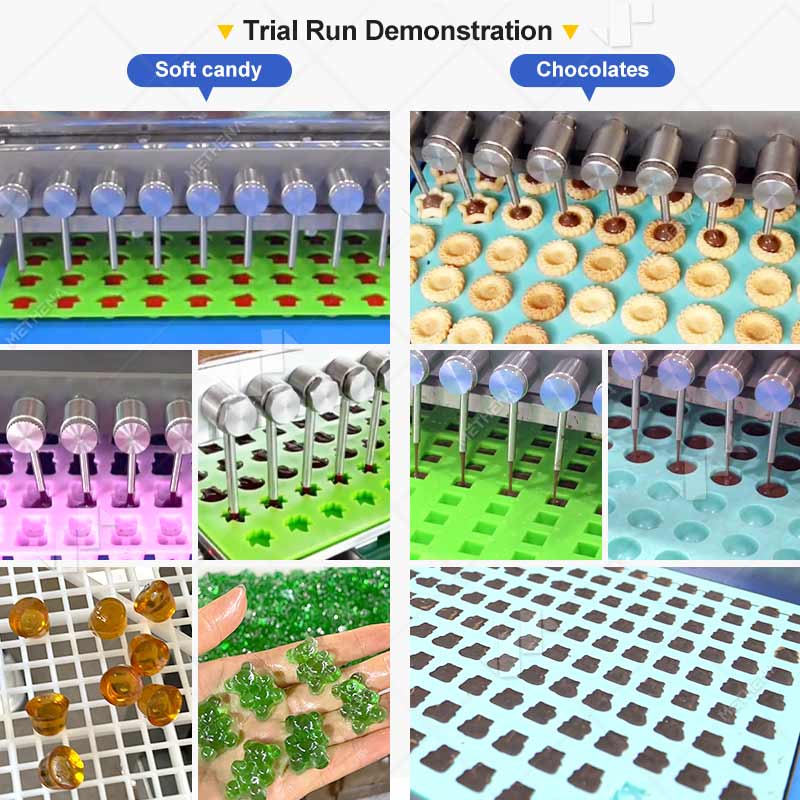
Confectionery R\&D laboratories.Formula work needs small batches, many variables and fast iteration. The 0.2 g minimum shot makes micro-sampling practical, and two stored recipes cut the switch time between comparison runs to one menu recall. When pilot data maps to production logic, new product launches move faster.
Small candy workshops.Most of these shops rotate hard candy, gummies, toffee and jelly through the same equipment. Recipe-change capability matters more than peak capacity on one product, and 60–100 kg/h matches single-shift targets of roughly 300–500 kg.
Bakery and dessert studios.Handmade candy as a high-margin side line is usually held back by inconsistent output, not demand. An all-in-one machine moves cooking quality from a skilled hand to reproducible parameters, which shortens training for new staff.
Central kitchens for chain stores.A central kitchen must supply the same product spec to every outlet, so batch consistency is the whole business. PLC recipe memory reproduces the same parameters at any time, keeping outlet output uniform.
Pilot lines and scale-up validation.Between lab and full line there needs to be a machine that simulates continuous production rhythm. The conveyor-based continuous pouring mode exposes how a formula behaves under sustained operation, which one-pot lab samples do not show.
Chocolate depositing, tempered mass only.The machine can deposit chocolate and filled products, provided the mass arrives already tempered or refined. It handles depositing and forming; it does not temper chocolate.
Q1. What candies can this machine produce?Hard candy, gummies, toffee/caramel, jelly candies and molded deposited lollipops, each with the matching forming mold. Chocolate-type products can be deposited, but the mass must be tempered beforehand.
Q2. What is the minimum shot weight?Down to 0.2 g per shot, with common settings from 1 to 7 g, adjusted on the touchscreen against the recipe and cavity size. Run test shots and weigh them before a full batch.
Q3. Can depositing speed and shot size be adjusted on site?Yes. Shot weight, stroke frequency and conveyor speed are set in the touchscreen menu without mechanical changes, so a recipe change is a parameter recall rather than a machine adjustment.
Q4. Are custom molds available?Yes. Silicone mold cavities, sizes and layouts are made to your product design, or you can supply your own mold for compatibility confirmation.
Q5. Is electric heating efficient?Heating uses an electric thermal-oil jacket with a shorter warm-up chain than direct fire or steam, and no boiler standby loss. For daily eight-hour operation the running-cost difference shows clearly on the electricity bill.
Q6. Can process parameters be saved?The PLC stores two recipe sets covering cooking temperature, time and depositing settings, and the conveyor runs in single or double mode without restructuring the parameters.









 Request a Quote
 More Products