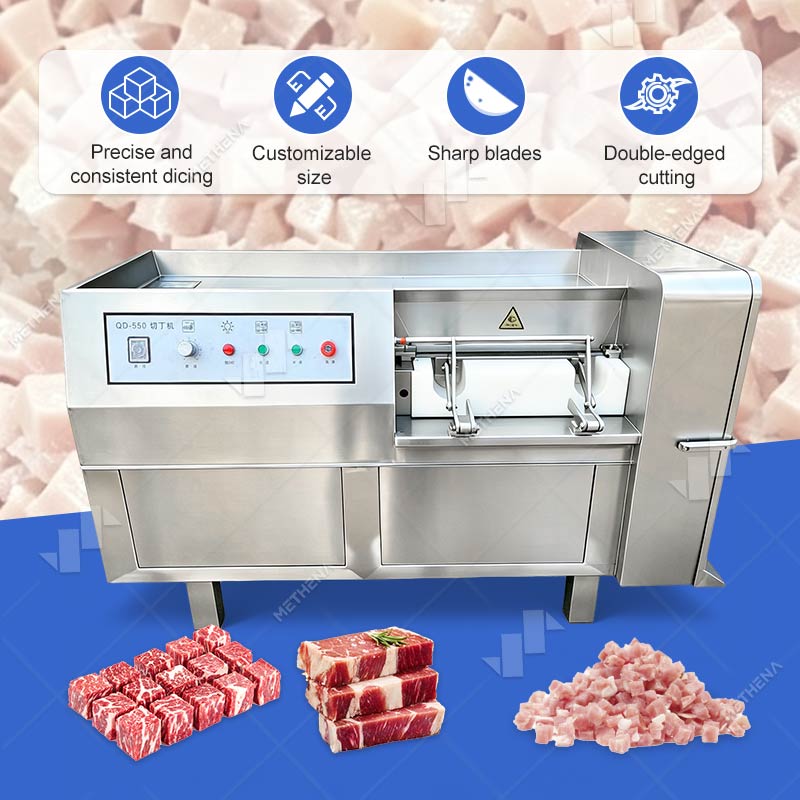
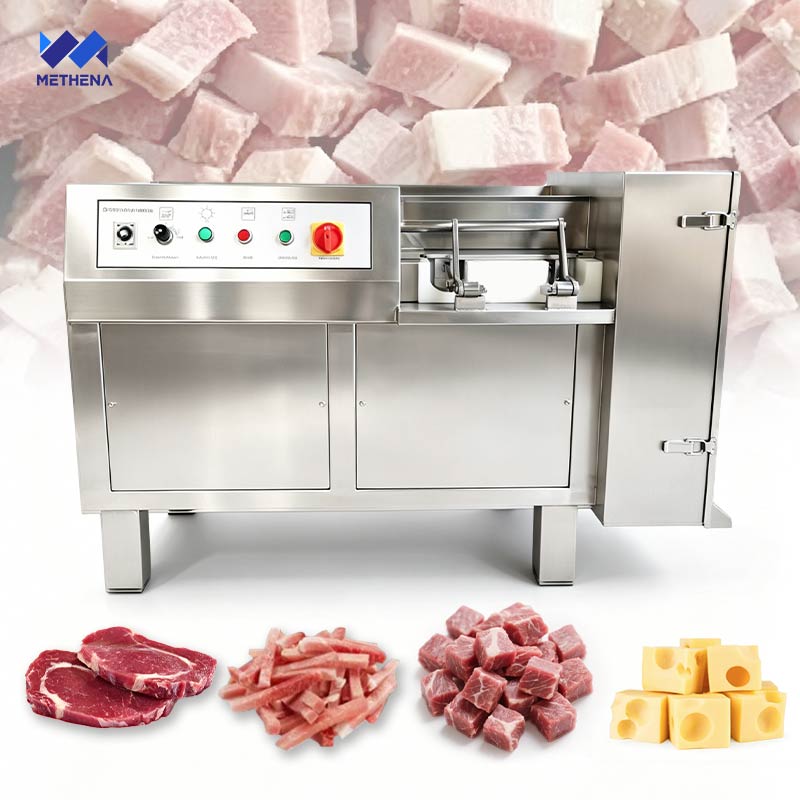
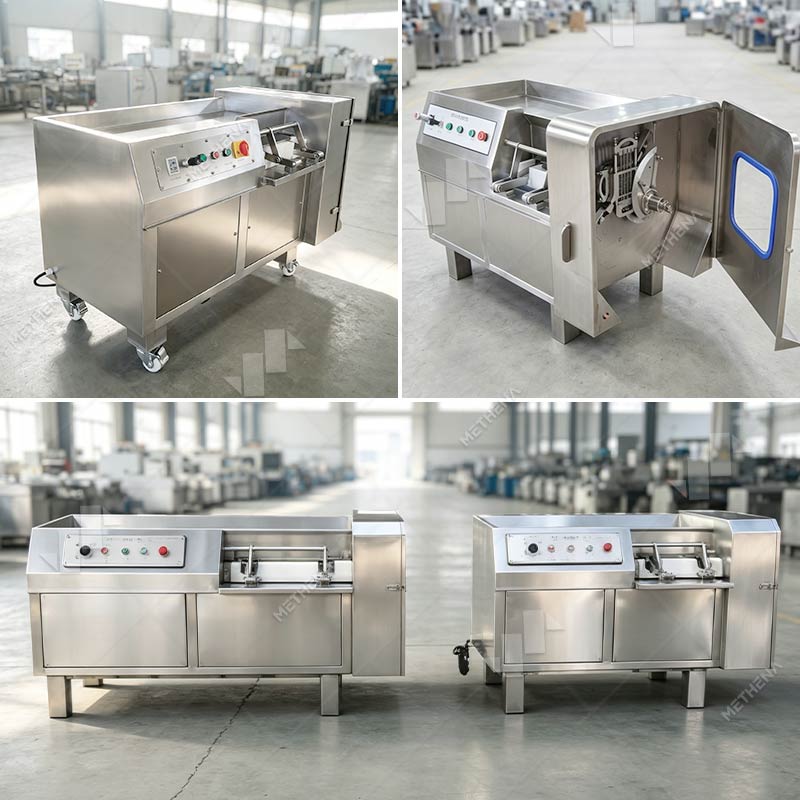
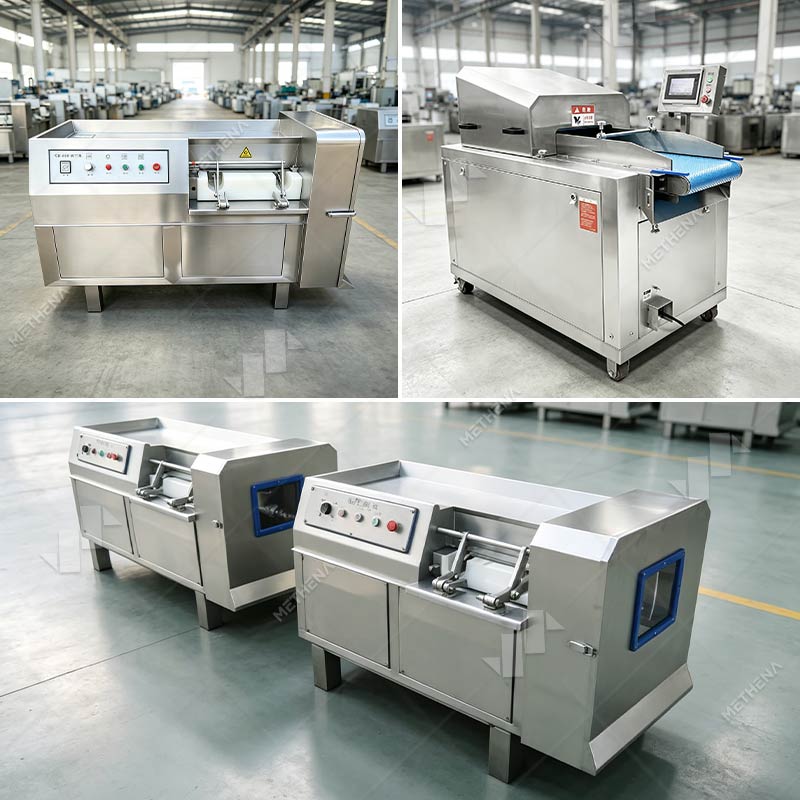
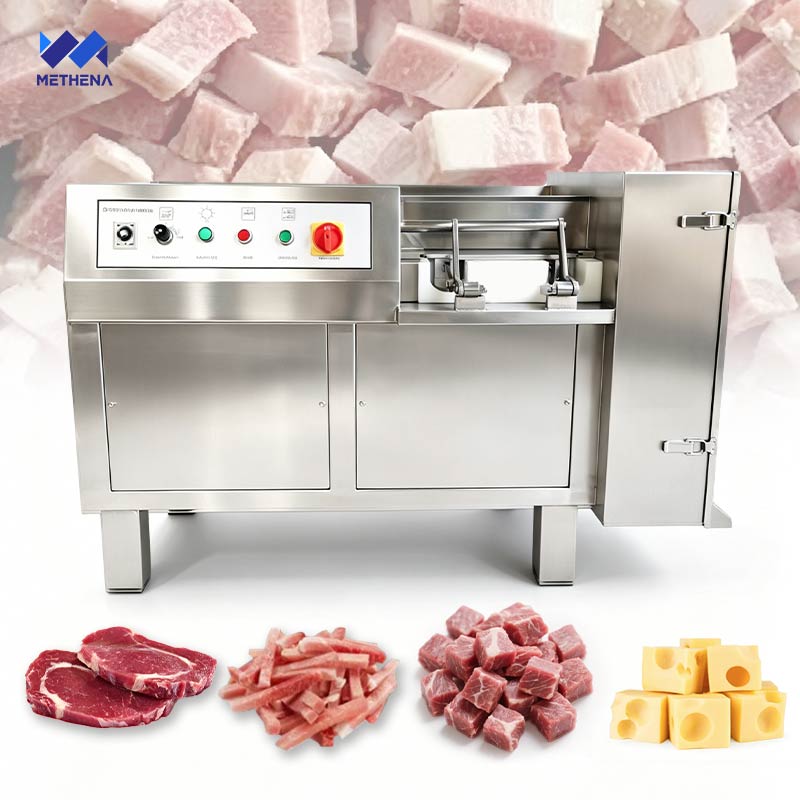
The Gondor frozen meat dicer offers a range of models with capacities spanning from 500 kg/h to 900 kg/h. It features adjustable cutting sizes (ranging from 4 mm to 40 mm) and supports a maximum cutting length of 550 mm. Whether processing frozen chicken breast cubes, beef chunks, cheese cubes, or fat dices, the equipment delivers consistent cutting precision and continuous output, laying a solid foundation for scalable, standardized pre-processing operations.
| Voltage: | 110V/220V/380V |
| Power (Watts): | 3KW/3.7W |
| Weight: | 260KG |
| Dimensions (L x W x H): | 1480*800*980mm/1940*980*1100mm |
| Product name | Frozen meat dicing machine |
| Capacity | 500-600kg/h,700-900kg/h |
| Cutting groove size | 84x84x350mm |
| Material | SUS304 Stainless Steel |
| Power source | Electric |
| Certification | ISO 9001, ISO 14001, ISO 45001, CE, BSCI, ETL |
| Cutting grid size | 4, 5, 6, 7, 8, 9, 11, 13, 16, 20, 27 mm |
| OEM/ODM Service | Acceptable |
| Function | Dicing Slicing Frozen Meat |
In the pre-processing stage of deep meat processing, the cutting of frozen meat has long faced an efficiency bottleneck: manual dicing is labor-intensive and results in inconsistent specifications and unstable yields, while standard meat-cutting equipment struggles to balance the hardness of frozen meat with cutting precision. The industrial frozen meat dicer is the key solution to this challenge; it processes raw materials—such as frozen meat blocks and fat at temperatures between -5°C and -10°C—without requiring full thawing, cutting them in a single pass into uniformly sized, sharply defined cubes, strips, or slices.
For processing plants or central kitchens handling tons of frozen meat daily, the primary challenges of dicing lie not in the ability to cut, but in achieving uniform shapes, controlling waste, and meeting the specifications required for downstream processes. An industrial frozen meat dicer addresses three core operational issues: capacity constraints caused by the low efficiency of manual dicing, uneven cooking results due to inconsistent cut sizes, and low raw material utilization rates.
| Model | Voltage | Power | Capacity | Grid size | Cutting groove | Weight | Machine size (L×W×H) |
|---|---|---|---|---|---|---|---|
| GD-350 | 110/220/380 V | 3.2 kW | 500–600 kg/h | 5–27 mm (custom) | 84×84×350 mm | 500 kg | 1480×800×980 mm |
| GD-550 | 110/220/380 V | 3.7 kW | 700–900 kg/h | 5–27 mm (custom) | 120×120×550 mm | 700 kg | 1940×980×1100 mm |
The standard grid covers roughly 4–27 mm for cubes, strips, and slices. Power supports 110/220/380 V, and a 110 V build suits the North American market. The machine cuts boneless frozen meat only; hard bone will damage the blades.
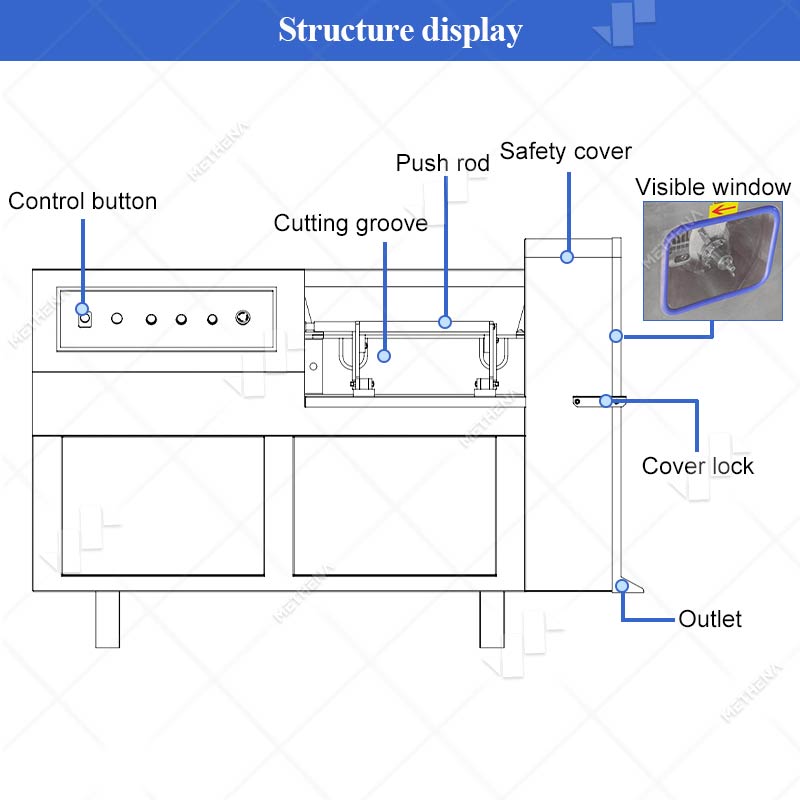
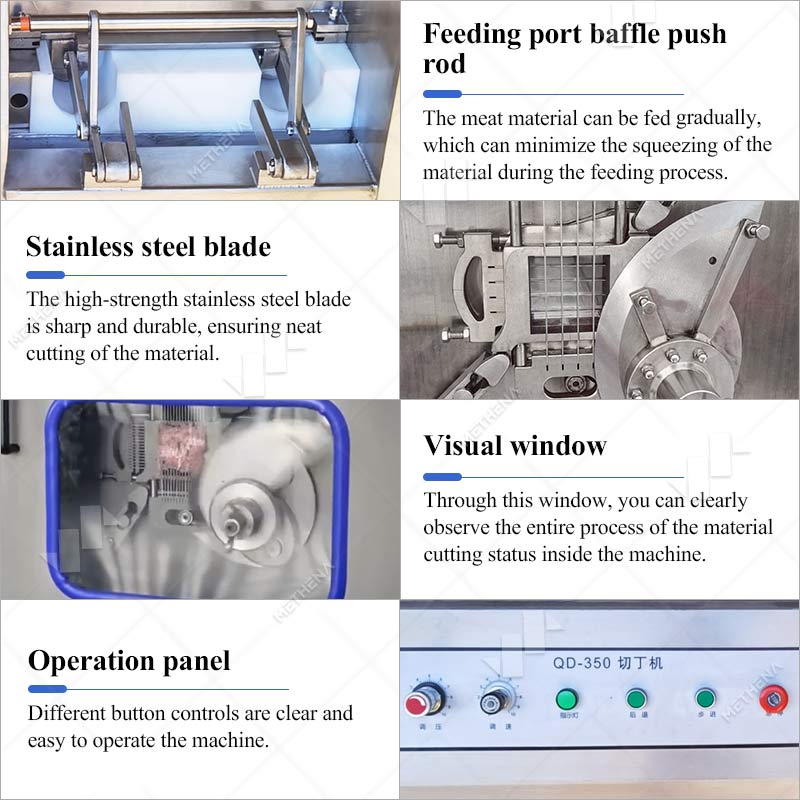
Hydraulic Pushing System (Power Core): Comprising a hydraulic pump, cylinder, and push rod, this system smoothly advances the frozen meat into the cutting zone. Compared to mechanical cam-driven systems, hydraulic drive offers uniform thrust, adjustable speed, and robust overload protection; if excessively hard material is encountered, the system automatically releases pressure to safeguard the blades, preventing breakage caused by hard impacts.
Blade Grid Assembly (Primary Cutting Core):Consisting of multiple parallel stainless steel blades, this assembly cuts the frozen meat into strips. The grid specifications determine the width of the meat strips and, consequently, the size of the final diced product. The blades are made of high-strength stainless steel, ensuring sharpness and durability. As the blade grid assembly is a wear part, it requires periodic replacement based on processing volume.
Main Cutting Blade (Secondary Cutting Core):A high-speed rotating circular blade or a reciprocating cutter that slices the meat strips crosswise into cubes. The speed of the main blade must be precisely synchronized with the pushing speed; excessively low speeds result in incomplete cuts and clumping, while excessively high speeds increase energy consumption and blade wear.
Safety Guard and Viewing Window (Safety Core):
A fully enclosed safety guard physically isolates the cutting zone from operators, preventing accidental contact. The viewing window is made of high-strength transparent material, allowing operators to monitor the cutting process in real-time without frequently opening the cover for inspection.
Frozen Meat Dicing Machine Workflow
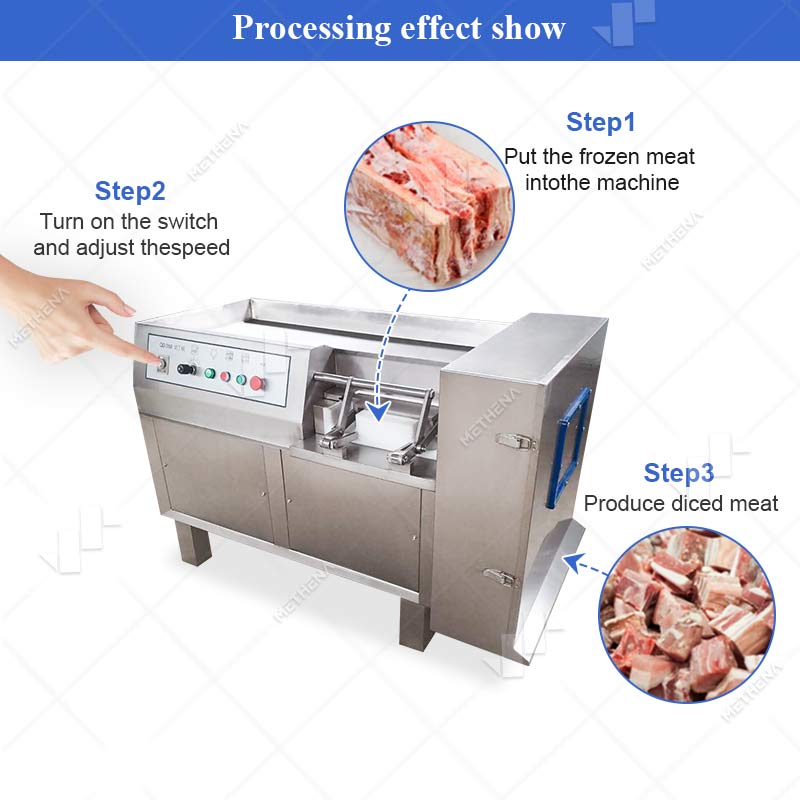
How does the frozen meat dicing machine work? Frozen meat blocks enter the chute through the feed inlet, and a hydraulic pump pushes the material into the cutting chamber. A blade grid moves in a reciprocating motion to first cut the meat into strips; the main cutting blade then cuts these strips into cubes, completing the process in a single step. The resulting meat cubes are uniform in size with clean, sharp edges.
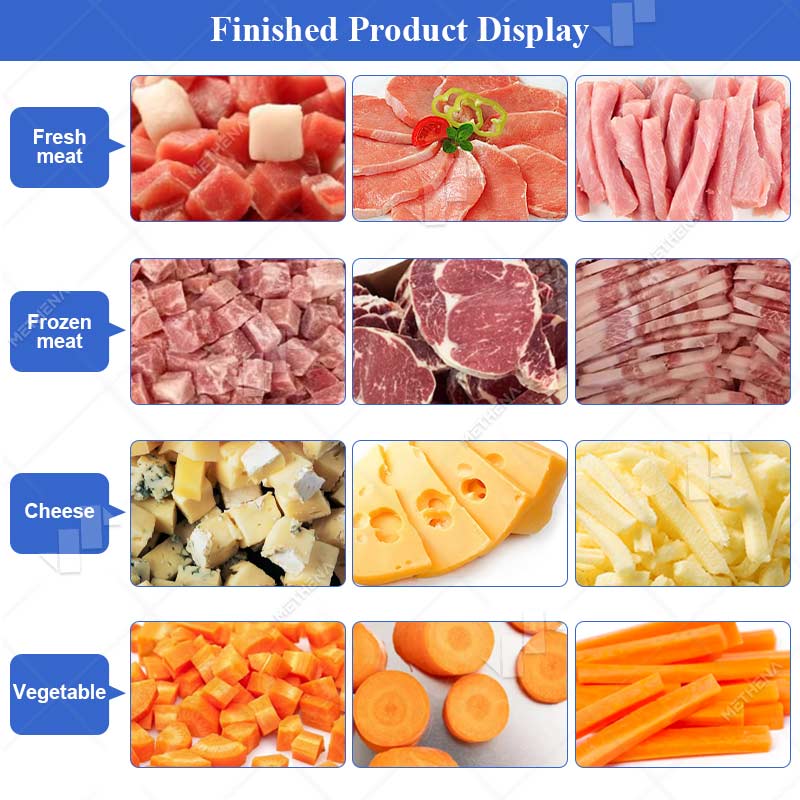
There is no need to switch machines to change specifications. By adjusting the number and spacing of the blades within the grid, the same piece of equipment can produce cubes, strips, or slices of various sizes. Whether cutting large chunks for subsequent grinding or fine cubes for fillings, the requirement is met simply by changing the blade grid.
First, it saves on labor. A single operator can run the machine, replacing multiple manual stations—such as those for thawing and hand-chopping—and it can operate continuously through night shifts without issue.
Second, it ensures consistency. Dices cut using the same blade grid remain uniform across batches; this makes it easier to control ratios during subsequent grinding and mixing, ensuring product flavor doesn't fluctuate (e.g., being too salty one day and too bland the next).
Third, it preserves quality. Cutting frozen meat directly—without thawing—minimizes juice loss and shortens the window for microbial growth; this process is more hygienic than thawing before cutting and also reduces cold storage energy consumption.
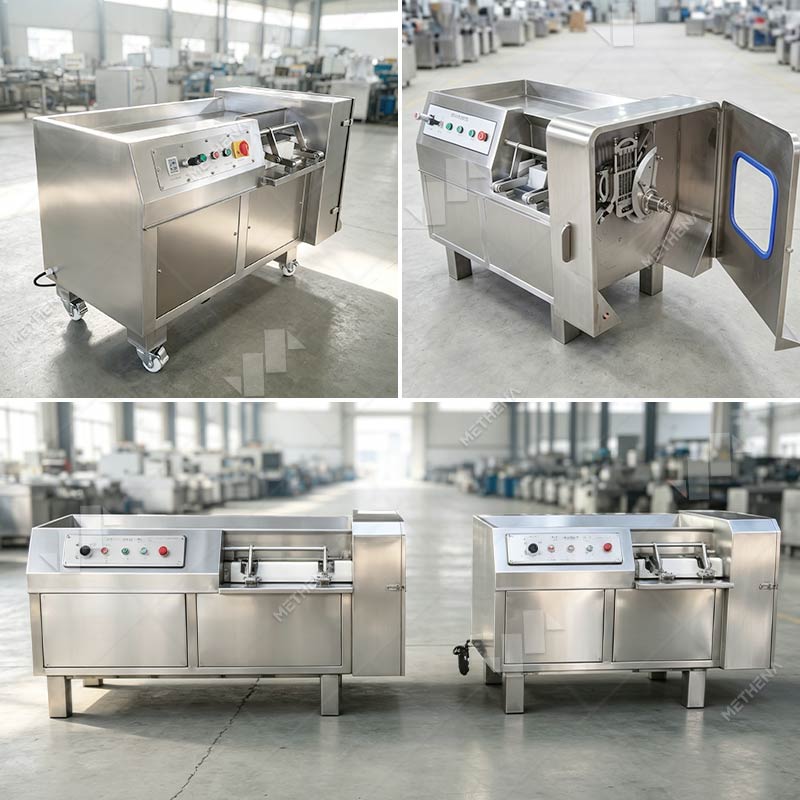
Meat processing plants: Pre-processing and cutting of ingredients for products such as ham sausages, meatballs, and fillings.
Snack and fast-food companies: Portion-controlled cutting of ingredients (e.g., diced chicken or beef) for small-package products.
Central kitchens and large-scale canteens: Bulk preparation of frozen meat cubes for stews and stir-fries.
Chinese and Western restaurants and delis: On-site preparation, cutting meat into cubes or strips as needed.
Ready-to-cook/eat meal companies: Direct supply of standardized meat cubes to ensure consistency and reduce kitchen variability.
Pet food: Cutting of meat-based ingredients (with specifications adjusted according to recipes).
Q: How small can the diced pieces be?
A: Standard cutting grids cover a range of approximately 4–27 mm. Different sizes—including cubes, strips, and slices—can be produced by changing the grid or adjusting the blade spacing on the same machine.
Q: Does frozen meat need to be thawed?
A: No. The machine cuts frozen meat blocks directly, eliminating the thawing step; this minimizes juice loss and reduces the time window for microbial growth.
Q: Can it cut meat with bones?
A: No. It is suitable only for boneless frozen meat; hard bones can damage the blades. Small, soft cartilage in poultry should also be removed beforehand.
Q: Is it easy to clean?
A: The blade assembly and feed chute are detachable and can be cleaned with warm water and detergent. Assembly and disassembly are quick and easy when switching products, meeting workshop hygiene standards.
Q: What is the hourly cutting capacity?
A: The GD-350 processes approximately 500–600 kg/h, and the GD-550 processes about 700–900 kg/h, depending on the meat block size and grid specifications.
Q: Is the noise level high?
A: The drive mechanism features noise-reduction technology; operating noise is lower than that of older reciprocating models, making it suitable for continuous workshop use.
Q: What types of meat can it cut?
A: It handles boneless frozen blocks of beef, pork, chicken, and lamb, as well as other frozen products of similar hardness.
Q: What equipment is needed after cutting?
A: The diced meat is typically transferred to a vacuum packaging machine for sealing or sent to subsequent processing stages, such as grinding, mixing, or sausage stuffing.











 Request a Quote
 More Products