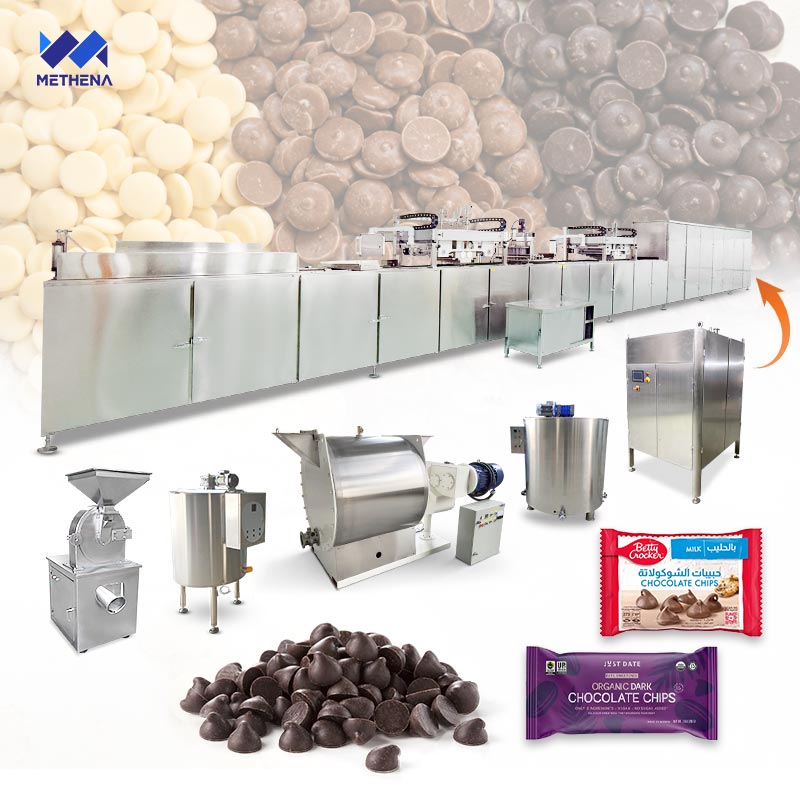
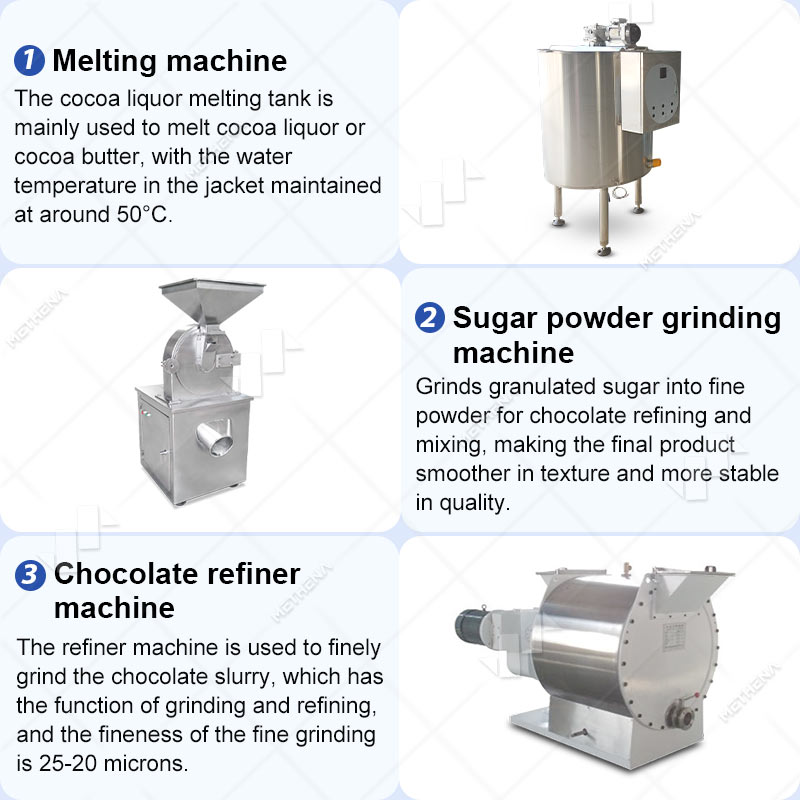
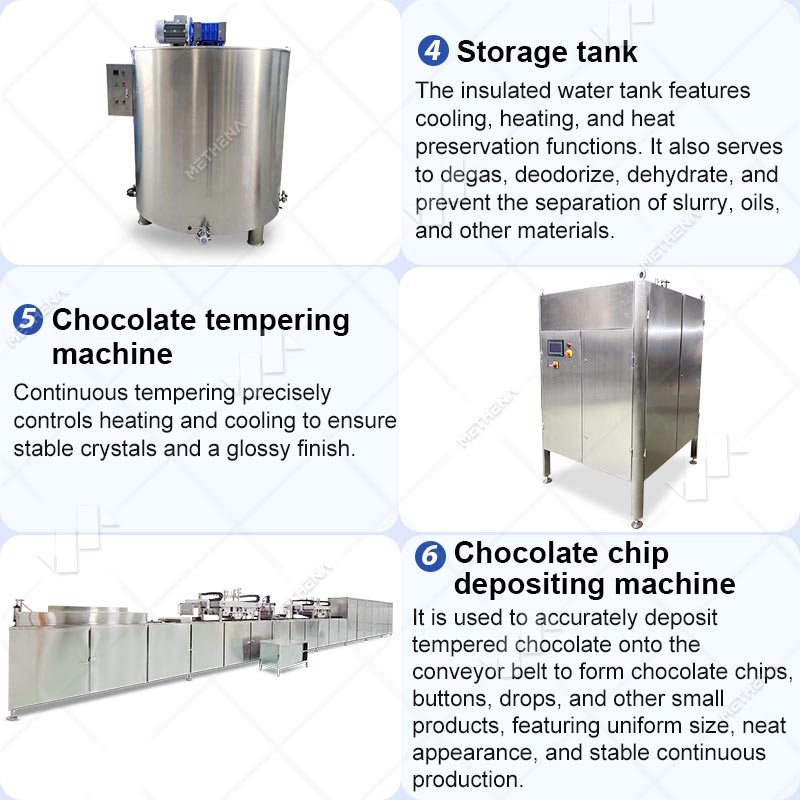
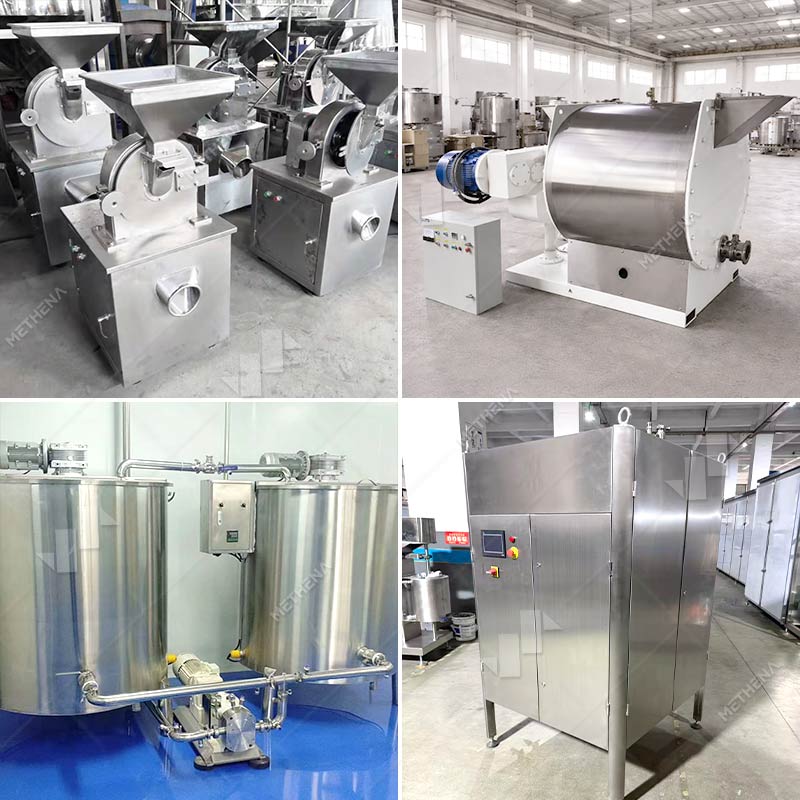
Chocolate chips and drops are high-volume standardized ingredients across baking, snack, and frozen dessert manufacturing. The production challenge is not shaping chocolate into particles. It is making every particle identical in weight, shape, and release state. When a bakery folds chocolate drops into cookie dough, a few percent of weight drift changes how the chocolate distributes and melts in the finished product. When a contract supplier ships bulk drops, any out-of-range batch-to-batch variation is a return.
| Function | Making chocolate chips/ drops |
| Applicable Industries | Manufacturing Plant, Food & Beverage Factory, Food Shop, Food & Beverage Shops |
| Gas source | 0.4Mpa |
| Single Grain Weight | 0.1-3g |
| Cooling Tunnel Temperature | 0-10℃ |
| Depositing Speed | 0-20(times/min) |
| Machine Length | 10-30m |
| Suitable for | Chocolate Products Making |
| OEM/ODM Service | Acceptable |
| Certification | ISO 9001, ISO 14001, ISO 45001, CE, BSCI, ETL |
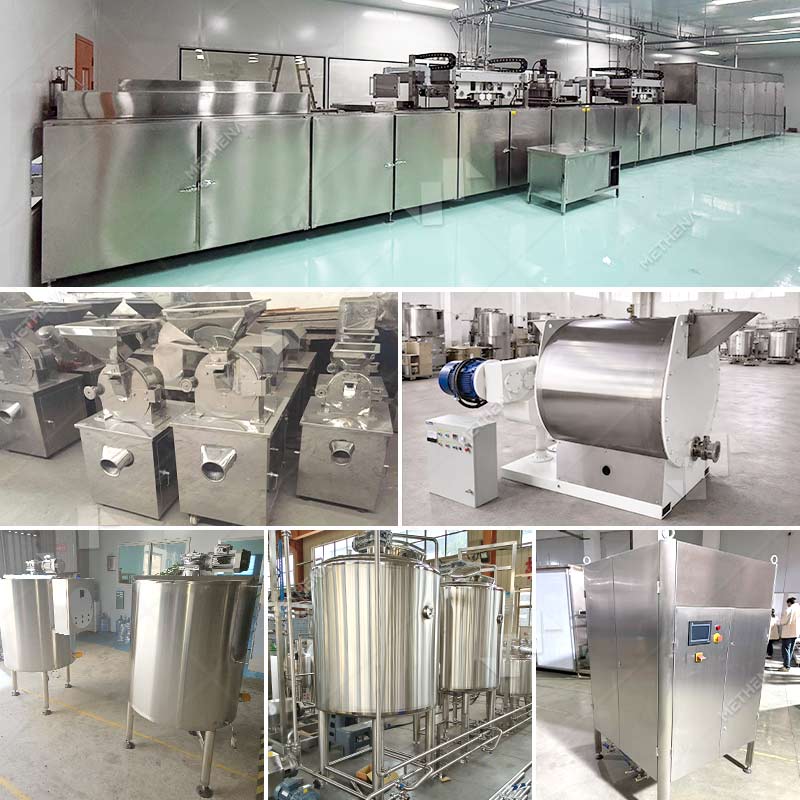
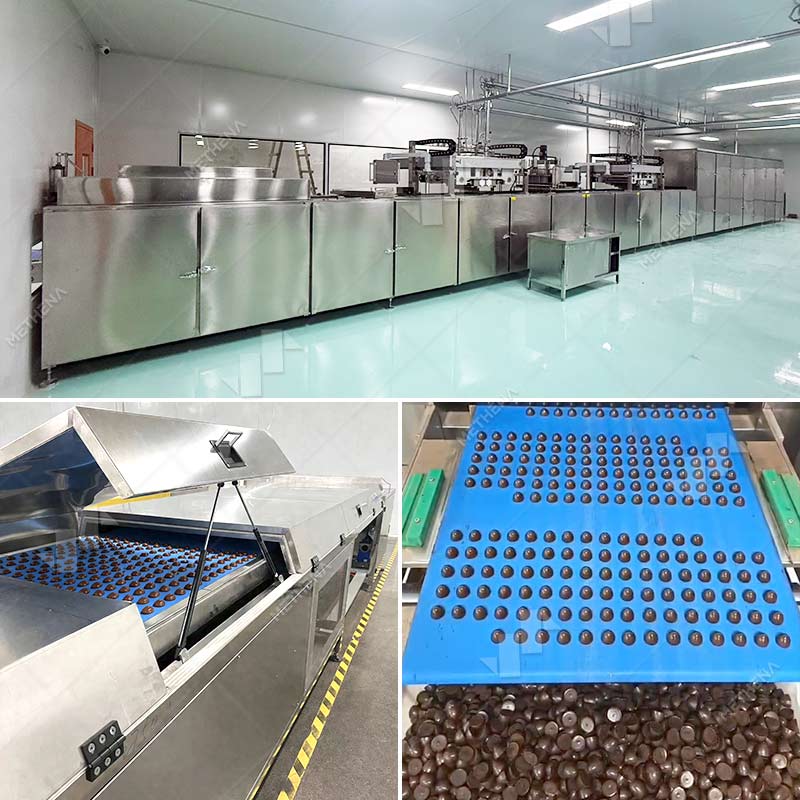
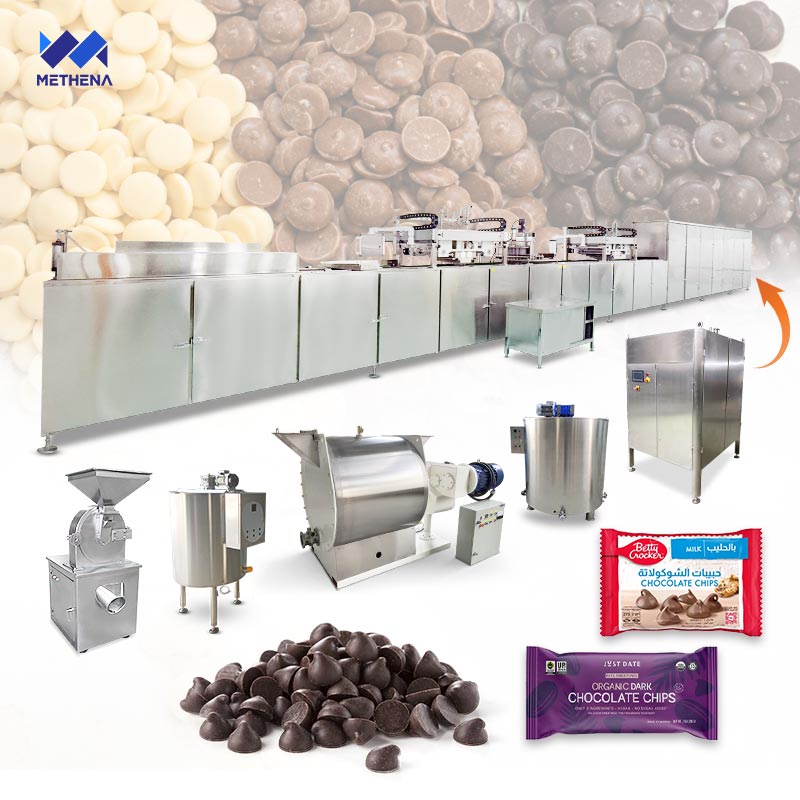
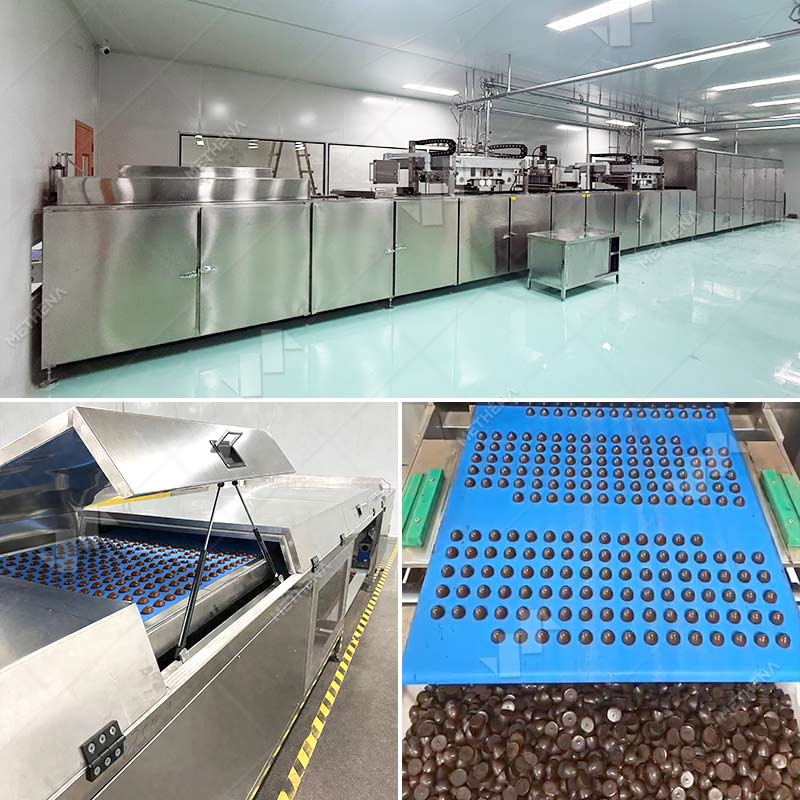
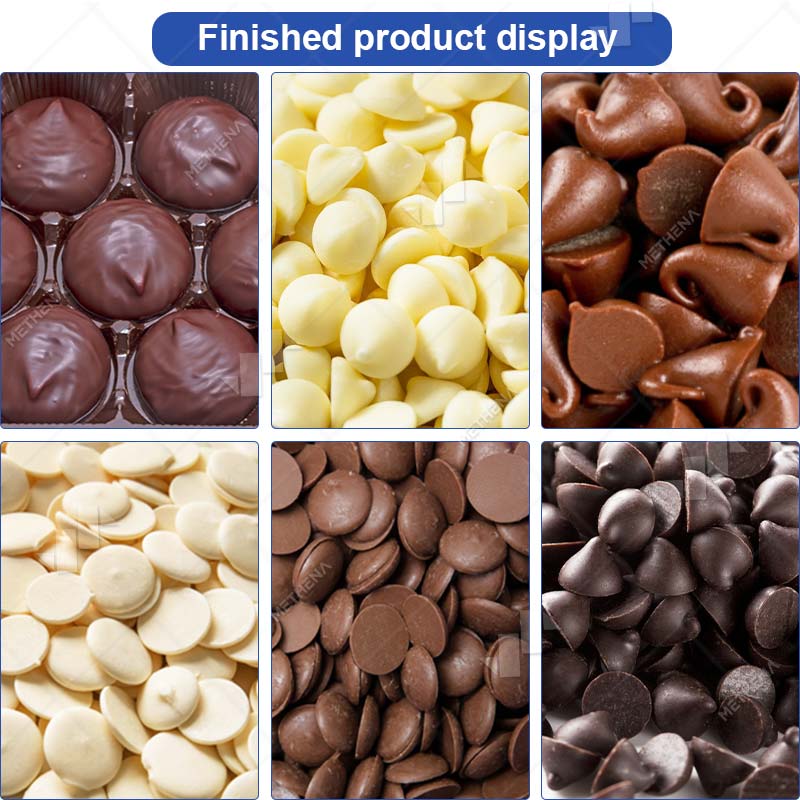
The Methena chocolate dripping production line addresses the most terminal and most repeatability-sensitive stage of the chocolate process chain. It takes tempered, viscosity-stable chocolate mass and continuously deposits it onto a PU conveyor belt at a preset single-grain weight (0.1-3 g), then cures and naturally demolds it through a multi-stage cooling tunnel to produce uniform chocolate particles or coating blanks. The line is offered in two base configurations, plunger-type and roller-type, with belt widths from 400 to 1200 mm configurable to capacity and shape requirements.
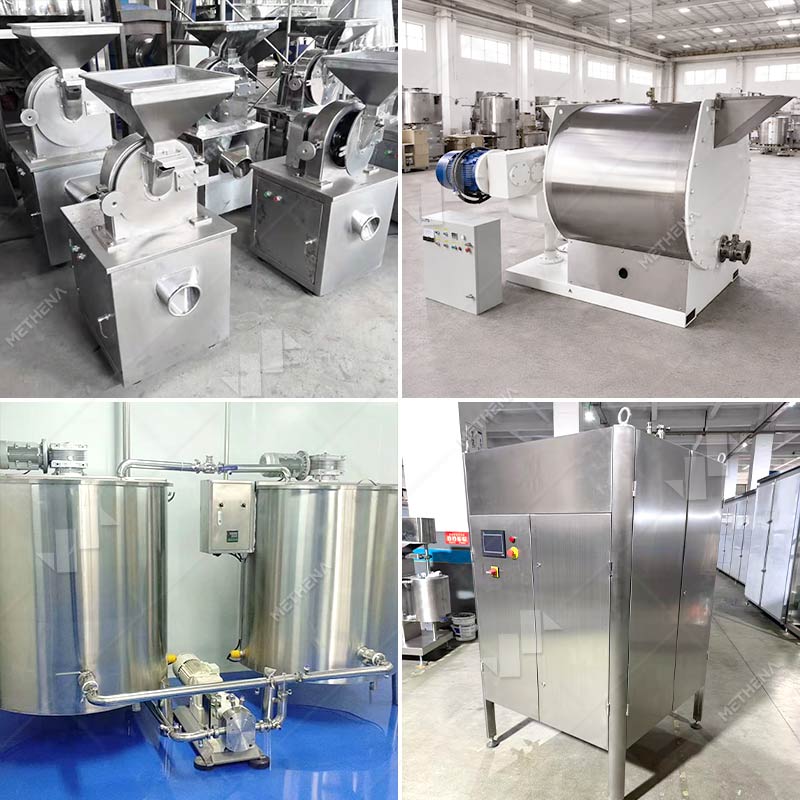
One clarification matters: the dripping line does not include melting, grinding, or tempering. Material entering this equipment must be fully tempered chocolate mass. Its role is forming and curing, not converting cocoa liquor into drops. This defines exactly how it interfaces within a larger line.
Parameter | MT-CDL400 | MT-CDL600 | MT-CDL800 | MT-CDL1000 | MT-CDL1200 |
Capacity at 0.1 g grain (kg/h) | 35 | 55 | 70 | 90 | 110 |
Capacity at 1 g grain (kg/h) | 85 | 135 | 170 | 225 | 275 |
Total Power (kW) | 11 | 12 | 18 | 18 | 23 |
Belt Width (mm) | 400 | 600 | 800 | 1000 | 1200 |
Machine Weight (kg) | 2300 | 2500 | 2600 | 3000 | 3400 |
Overall Dimension (mm) | 12000×850×1600 | 12000×1050×1600 | 12000×1250×1600 | 12000×1450×1600 | 12000×1650×1600 |
Cooling Channel Temp (°C) | 0-10 | 0-10 | 0-10 | 0-10 | 0-10 |
Deposit Rate (cycles/min) | 0-20 | 0-20 | 0-20 | 0-20 | 0-20 |
Single Grain Weight (g) | 0.1-3 | 0.1-3 | 0.1-3 | 0.1-3 | 0.1-3 |
Machine Length (m) | 10-30 | 10-30 | 10-30 | 10-30 | 10-30 |
Note: Capacity varies significantly with single-grain weight; the table lists two typical grain weights, 0.1 g and 1 g. Actual output is jointly determined by grain weight, deposit rate, and belt width. Standard supply is 380V / 50Hz / 3P with 0.4 MPa air, customizable for export markets.
The line's action divides into four continuous stages, each corresponding to a critical control point.
Stage One: Insulated Holding and Viscosity Management. Tempered chocolate mass enters an insulated constant-temperature system that holds the mass within its deposit-ready viscosity window. Viscosity stability is the precondition for consistent drop weight. Too high, and the drop tails and strings; too low, and the landing point spreads and the size shrinks. The holding system's job is to compress this source of variation to a minimum.
Stage Two: Multi-Head Programmable Depositing. The mass is delivered to a high-precision depositing unit that drips it onto the PU belt below at a set frequency. The unit supports independent programming across multiple heads, each controlling flow rate and landing position so that within a single batch every chocolate piece stays within a tight weight distribution. Deposit rate adjusts from 0 to 20 cycles per minute to match belt width and capacity.
Stage Three: Multi-Stage Cooling and Curing. The belt carrying the liquid drops moves into a multi-stage cooling tunnel, where the mass solidifies evenly under a 0-10°C temperature profile. Staged control avoids the surface-stress cracking and incompletely crystallized core that come from abrupt cooling. Cool too fast and the skin sets while the center stays soft; cool too slow and the tunnel length becomes the capacity bottleneck.
Stage Four: Return-Roller Natural Demolding. Cured chocolate travels with the belt to the end return roller. The PU belt turns at the roller, and the set pieces release by gravity and belt curvature, completing demolding. This structure relies on no pin ejector or air-blow mechanism, removing a class of mechanical damage points and failure sources.
Insulated holding and viscosity control. The holding section uses an actively temperature-controlled structure rather than a passive hopper. Chocolate mass waiting to be deposited loses temperature and gains viscosity if left unmanaged, directly altering drop shape; active holding is necessary process redundancy, not an optional extra.
Depositing unit: plunger and roller configurations. The plunger type meters and deposits each piece with an independent piston, giving high single-grain weight accuracy suited to irregular shapes, logo embossing, and smaller specifications. The roller type discharges continuously through rotating cavities, delivering higher per-time output for high-volume standard drops. Both share the same holding, conveying, and cooling framework; the difference concentrates in the deposit head.
PU conveyor belt and return-roller demolding. The belt surface uses food-grade PU, flexible, non-stick to set chocolate, and releasing naturally at the end return roller. Belt material choice directly affects demolding completeness and food-contact safety; a standard industrial belt is not a substitute.
Multi-stage cooling tunnel. The tunnel operates within 0-10°C, distributing cooling capacity by curing curve. The refrigeration unit and air duct design must match belt width and deposit rate, or curing becomes uneven: skin set at the front, soft core at the back.
Pneumatic and electrical control. The line requires a 0.4 MPa air supply for head actuation and auxiliary execution. Main electrical control is handled by the PLC, with non-food-contact structural parts selected to industrial standards. Standard supply is 380V / 50Hz / 3P, customizable to destination grid.
Food-grade materials. Parts contacting chocolate are built from food-grade SUS304 stainless steel; the belt is food-grade PU. This satisfies the basic compliance requirements for food-contact materials and supports routine cleaning and hygiene management.
1. Drop-weight consistency determines downstream usability. Multi-head programmable depositing paired with constant-viscosity holding keeps intra-batch weight deviation within a narrow band. For contract suppliers shipping bulk drops, consistency means traceable formulation and stable customer acceptance. For bakeries, it means even chocolate distribution across every tray.
2. Viscosity stability suppresses defects at the source. The insulated holding system locks mass viscosity inside the deposit window, preventing the tailing, stringing, and landing drift that define manual depositing failure. These faults are nearly impossible to eliminate by hand, and that is precisely why an automated line earns repeat orders.
3. The cooling tunnel is not the capacity bottleneck. The multi-stage 0-10°C tunnel controls temperature by curing curve, letting particles crystallize at a steady pace on the belt, completing demolding without over-consuming tunnel length. Even at 1200 mm width with deposit rate maxed out, the curing pace keeps up with the upstream depositing rhythm.
4. Return-roller demolding lowers maintenance burden. The PU belt peels off naturally at the end roller, eliminating pin or air-blow demolding mechanisms that wear and fail. One fewer moving part means one fewer failure class and one fewer hygiene dead zone. This is decisive for a line expected to run continuously.
5. Changeover flexibility supports multiple SKUs. Quick-change heads and mold systems cover particle specifications from 10-50 mm diameter and 3-8 mm thickness, with logo embossing supported. Dark, milk, white, and compound coatings all adapt. For workshops and gift companies built on variety and small batches, this means no separate line per product family.
6. Control and serviceability lower the operator barrier. A PLC with touch-screen HMI sets temperature and speed with one action, with live status and fault diagnosis visible in real time. Modular construction shortens wear-part replacement and on-site service time, which matters most for factories without a dedicated equipment engineer.
Large chocolate manufacturers. The most direct user. Bulk drops and chips serve as own-brand products or downstream ingredients, where drop-weight consistency delivers batch stability and mold changeovers cover different standard specifications.
Bakery and dessert ingredient processors. Chocolate drops and nibs are core ingredients in cookies, muffins, and dessert premixes. A dripping line supplies weight-stable particles that directly determine chocolate distribution and melt behavior in the baked product, giving more control than buying bulk drops externally.
Snack food enterprises. Puffed rice, wafer sticks, and cereal balls with chocolate coating rely on stable depositing and cooling rhythm. For snack lines where chocolate is the selling point, particle uniformity and demolding completeness drive the visual grade after packaging.
Boutique chocolate workshops. The home of small-batch, multi-shape demand. Quick mold change and logo embossing let a workshop trial new specifications without adding equipment, at an operator barrier low enough for a small team.
High-end hotels and restaurant chains. Dessert decoration and custom chocolate ingredient scenarios. The line responds quickly to back-kitchen small-batch, multi-variety needs, raising both dessert output efficiency and visual presentation.
Gift and seasonal food companies. Gift-boxed assortments and limited seasonal products often require irregular shapes and multi-layer flavored particles. The line's flexible changeover supports the dispersed production of these non-standard orders, helping products differentiate on the shelf.
Handmade chocolate studios. Intuitive operation and flexible shaping let a studio produce niche flavors and creative forms without complex tuning, lowering the entry barrier of manual production.
Ice cream and frozen dessert producers. Chocolate particles as crisp coatings and inclusions demand high demolding completeness and shape consistency. Staged cooling control matters most here, because repeated freeze-thaw amplifies surface defects from fat migration.
Q1: How is a dripping line different from a full chocolate production line?A dripping line only deposits tempered chocolate mass into particles and cools and demolds them; it includes no melting, grinding, or tempering. It handles the terminal forming and curing stage of the process chain. Material entering the equipment must be fully tempered chocolate mass, or drop shape and cure quality cannot be guaranteed.
Q2: Which fits me better, plunger or roller type?The plunger type meters and deposits each piece with an independent piston, giving high single-grain weight accuracy, suited to irregular shapes, logo embossing, and smaller specifications. The roller type discharges continuously through rotating cavities for higher per-time output, suited to high-volume standard drops. Production scale and shape complexity drive the choice.
Q3: How is drop-weight consistency guaranteed?A multi-head programmable depositing unit independently controls flow and landing per head, an insulated holding system keeps mass viscosity inside the deposit window, and a stable deposit rate (0-20 cycles/min) runs the line. Together these define the intra-batch weight deviation range.
Q4: What does 0.1-3 g single-grain weight mean, and why are there two capacity numbers?Capacity changes substantially with grain weight. On the same machine, 0.1 g versus 1 g grain yields several times the total weight per hour, so the spec table lists two typical grain weights. Select against your target grain weight and its corresponding capacity, not a single isolated figure.
Q5: Is the 0-10°C cooling tunnel temperature fixed?That range is the equipment operating window; the set point adjusts by recipe. Chocolates of different fat content and formulation have different optimal cure temperatures, and compound coatings differ from pure-fat chocolate. The curve is determined against material properties during commissioning.
Q6: Must the machine use 380V and 0.4 MPa air?Standard configuration is 380V / 50Hz / 3P supply plus 0.4 MPa air. Export orders can be customized to destination grid voltage and frequency. Air pressure must meet the basic requirement of head actuation. State your local conditions at inquiry.










 Request a Quote
 More Products