Author: Methena / Release Time: 2026-07-09 / Pageviews:
In modern meat processing, skinning has long been a bottleneck affecting production capacity and product value. Manual skinning is not only labor-intensive but also difficult to maintain consistency. It leads to uneven skin thickness, meat damage, and large fluctuations in yield.
With rising global labor costs and increasingly stringent food safety regulations, more and more meat processing companies are turning to mechanized skinning solutions.
Pork skinning machines use rotating blades and a base plate to cleanly peel the skin from pork belly, shoulder, and other cuts of meat with minimal meat loss.
It not only replaces manual labor but also incorporates skin and fat separation into a standardized, repeatable processing system—ensuring consistent product specifications, reducing raw material waste, and maintaining high hygiene standards.
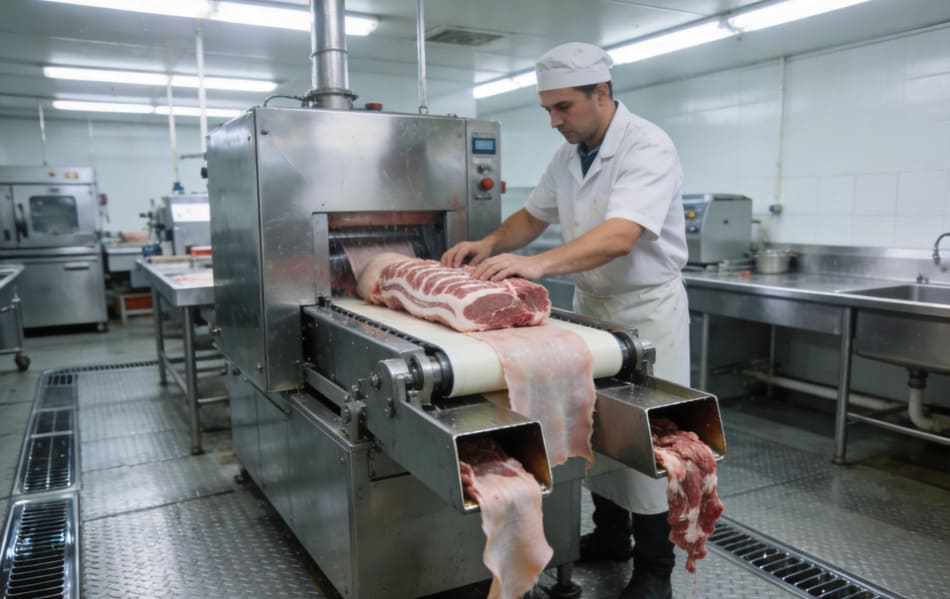
Whether it's a slaughterhouse, meat processing plant, central kitchen, or retail butcher shop, choosing a suitable skinning machine is a significant investment that impacts production efficiency, product quality, and long-term profits.
So, what key factors should you consider when purchasing a pork skinning machine? Here are seven key factors for your reference.
The first consideration when choosing a peeling machine is whether the equipment can keep up with your daily processing volume. Different models have significantly different capacities, usually measured in meters per minute or kilograms per hour.
Entry-level models are around 18 meters/minute, while larger models can reach 24 meters/minute or even higher. For processing plants operating on multiple shifts, the cumulative daily difference can be considerable.
When assessing capacity, consider not only current demand but also future business growth. If the machine just meets today's needs, it will become a new bottleneck once production increases; conversely, blindly pursuing excessive capacity means unnecessary capital expenditure and energy waste.
The blade is the most crucial component determining peeling quality. A high-quality blade system achieves clean and precise separation of skin and flesh—ensuring complete skin removal while minimizing flesh damage. Choose blades made of high-strength stainless steel alloy with precision-ground edges, which maintain sharpness over long-term use.
Equally important is adjustability. Different cuts of pork, such as pork belly, shoulder, and leg, vary in thickness and fat content. A machine equipped with an adjustable blade holder allows you to freely adjust the skin removal thickness (typically ranging from 0.5 to 6 mm), switching between different product specifications without changing parts.
At the same time, it's important to confirm whether the blades, as consumable parts, are readily available and reasonably priced—blade replacement cycles vary from one week to one month depending on workload, and foreseeable maintenance costs are an important consideration when selecting a machine.
In meat processing, equipment hygiene is paramount. The material of the machine body directly determines its cleanliness, corrosion resistance, and compliance with food safety regulations.
Stainless steel (typically 201 or 304 grade) is the industry standard for food contact surfaces—it is resistant to moisture and detergent corrosion, has a smooth, seamless surface, does not easily trap dirt, and meets international food safety standards.
Besides materials, the cleanability of the equipment is also crucial. Can it be easily disassembled for thorough cleaning? Are there any hard-to-reach areas where residue can accumulate? Models with fully welded stainless steel frames and minimal exposed fasteners are easier to clean and maintain over the long term.
The motor is the power source of the equipment, and its specifications directly affect performance and lifespan. Methena pork skinning machines typically offer motors ranging in power from 370W (small model) to 750W (large model), with voltage options of 220V or 380V to suit different national power grid standards.
Industrial-grade equipment features thermal protection and good ventilation, supporting long-term operation. While a high-quality motor requires a slightly higher initial investment, it offers long-term returns by reducing downtime and replacement frequency.
Protecting Personnel and Equipment Meat processing equipment, with its sharp blades and moving parts, prioritizes safety. A well-designed peeling machine should provide multiple layers of protection for operators while ensuring production efficiency.
Key safety features include: an emergency stop button (within operator's reach), a foot switch (hands-free start/stop), and a protective cover (to prevent accidental contact with the blades during operation). Some models automatically stop when the protective cover is opened—a crucial safety feature for cleaning and maintenance.
Besides operational safety, electrical safety is equally important: CE certification indicates compliance with EU health, safety, and environmental standards, while ISO 9001 certification represents a standardized quality management system.
A piece of equipment that is difficult to operate or maintain quickly becomes a source of trouble and lost productivity. Evaluate the equipment's human-machine interface: are the control buttons clearly labeled and intuitively easy to use?
Can operators learn to use it in minutes, rather than requiring days of training? Equipment with a simple, waterproof panel and clear labeling shortens the learning curve and reduces operational errors. Methena's pork skinning equipment can be moved as needed to adapt to the production line, requiring no fixed installation.
Furthermore, the availability of spare parts and the completeness of the manufacturer's technical documentation are crucial considerations: detailed manuals and online troubleshooting support can save significant time when problems arise.
The equipment itself is only half the battle; the supplier's long-term service capabilities determine your subsequent experience. When evaluating a supplier, first verify their industry qualifications: ISO 9001, CE, BSCI, ETL, and other certifications demonstrate that the manufacturer adheres to recognized quality and safety standards.
After-sales service is often overlooked in purchasing decisions.
Confirm warranty terms: A one-year warranty on core components is standard industry practice.
But what about technical support? Is 24/7 online troubleshooting provided? Can engineers be dispatched for on-site installation and training? Is the spare parts supply chain responsive?
For international buyers, these factors are just as important as equipment specifications. A supplier that can provide timely and professional after-sales support is worth the price, even if it is slightly more expensive. However, if there is no after-sales support, even the best equipment may become "scrap metal".
Choosing a pork skinning machine is a decision that requires a comprehensive balance of capacity, quality, hygiene, safety, and long-term support.
A machine that excels in all aspects may have a higher initial cost, but through higher yields, lower labor costs, consistent product quality, and fewer unexpected downtime, it will bring you a return far exceeding your investment.
Ready to choose the most suitable pork skinning machine for your factory? Contact our technical team and tell us your capacity requirements, processing areas, voltage, and customization needs. We will match you with the best model and provide complete technical information, international certifications, and global after-sales support to help you make an easy decision and start production with peace of mind.