Author: Methena / Release Time: 2026-04-17 / Pageviews:
In the meat processing industry, vacuum sausage fillers undoubtedly play a crucial role in the transformation from traditional workshops to modern, standardized operations. Faced with a dazzling array of specifications and technical parameters on the market, how do you choose a vacuum sausage filler that meets current production capacity while also allowing for future expansion?
In this article, Methena Machinery will provide an in-depth analysis of the essential knowledge for purchasing a vacuum sausage filler through ten key questions and answers.
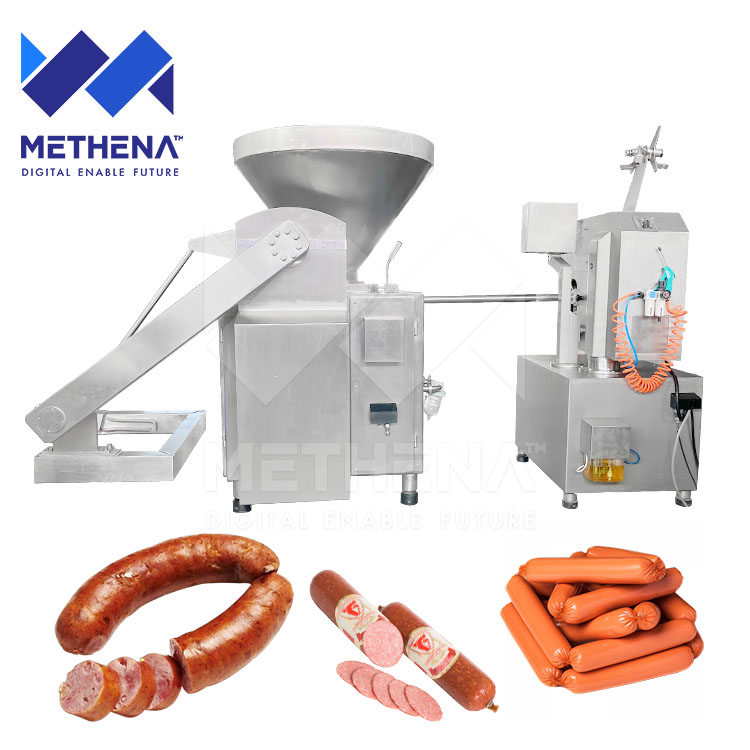
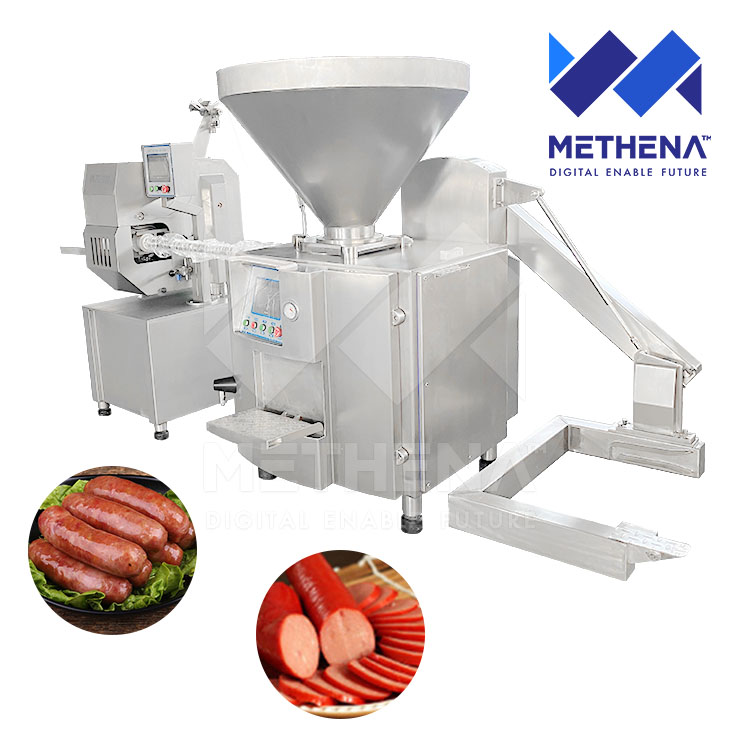
A: Simply put, vacuum solves two major industry pain points: air bubbles and oxidation. During the filling process, a vacuum environment effectively removes air from the meat filling. This not only prevents fat oxidation and decomposition, thus extending the product's shelf life, but more importantly, vacuum filling significantly reduces air bubbles in the finished product.
Imagine a sausage with a plump appearance, dense cross-section, and vibrant color—obviously more competitive in the market than a sausage full of holes.
A: Modern vacuum sausage filling machines are no longer limited to sausage making. Besides traditional meat and fish paste, they also excel in processed foods, condiments, and the packaging of thick sauces.
Furthermore, whether you use natural casings, collagen casings, or smoked casings, professional equipment can achieve a perfect match by adjusting pressure and flow rate, demonstrating excellent compatibility.
A: When selecting a model, "capacity" is the primary indicator. For example, with Methena's product line, small processing plants or laboratories can choose the 3200 model (output approximately 3200 kg/h), while large industrial production lines tend to favor the 6500 model (output up to 6000 kg/h). It is recommended that you allow 20% margin for growth when assessing capacity to avoid equipment bottlenecks during business expansion.
A: In large-scale production, accuracy equals profit. High-quality vacuum sausage filling machines (such as Methena's products) are precisely controlled by servo motors. Typically, the error for minced meat products can be controlled within ±2 grams, and even for materials containing chunks of meat, the error is only around ±5 grams.
This precision ensures consistent weight for every package leaving the factory, avoiding profit loss due to overweight products and mitigating compliance risks caused by short-weighting.
A: Food safety is the lifeline of any business; therefore, 304 stainless steel is the only standard. Not only the machine body, but all parts that come into direct contact with the minced meat must use food-grade materials.
Vacuum sausage filling machines made of this material are not only corrosion-resistant, able to withstand long-term erosion from seasonings and cleaning agents, but also have a smooth surface that does not easily accumulate oil, greatly reducing the probability of bacterial growth.
A: "Collaborative operation" is a characteristic of modern factories. An excellent sausage filling machine should have strong connectivity capabilities. It must not only be able to complete filling independently, but also seamlessly integrate with automatic tying machines, card-punching machines, or shearing machines.
This "integrated" filling and twisting production line significantly reduces manual intervention and improves overall production efficiency.
A: Absolutely critical. Industrial-grade equipment must be able to "feed without stopping." If the machine needs to be stopped to vent air every time it needs to be fed, efficiency will be greatly reduced.
High-efficiency vacuum sausage filling machines, through optimized hopper design, ensure that materials can enter the screw pump or vane pump smoothly and continuously, achieving 24/7 high-intensity operation.
A: Experienced operators know that ease of cleaning determines daily operating costs. When purchasing, the internal structure should be carefully examined to see if it supports quick disassembly.
Good design should minimize dead corners, allowing workers to remove residual meat scraps with a simple rinse. This not only meets HACCP hygiene standards but also saves valuable labor time.
A: Cumbersome manual adjustments are a thing of the past. Modern vacuum sausage filling machines are equipped with a user-friendly HMI (Human-Machine Interface) control panel.
Through the screen, you can adjust the number of twists, filling speed, and vacuum level in real time. For companies producing multiple product varieties, the system can typically store multiple sets of process formulas, which can be recalled with a single click when switching products, greatly reducing reliance on skilled workers.
A: Industrial equipment inevitably suffers from consumable wear and tear (such as sealing rings, cutters, etc.). Choosing a manufacturer like Methena that provides 24/7 technical support and global spare parts supply is crucial. A single day of equipment downtime not only results in lost output but also erodes customer trust.